Saturday, June 25, 2022

Notable Californians: A Series (Part 4.1a)

When I first had the idea to do a series of Notable Californians to help me get better acquainted with my new home state, I had no idea Norma Jeane Mortenson, Norma Jean Baker, Marilyn Monroe was a born and raised Angeleno.  I, for some reason, thought she was of the typical "girl from the Midwest dreams of Hollywood" trope.  Her life was so incredibly complicated, I may have to do this post in several segments.  

The Early Years

Marilyn Monroe was born as Norma Jeane Mortenson on June 1, 1926  at the Los Angeles County Hospital in Los Angeles, California.  Her mother, Gladys Pearl Baker (née Monroe) was from a poor Midwestern family who had migrated to California at the turn of the century.  At the age of 15, Gladys married John Newton Baker, an abusive man nine years her senior. They had two children named Robert (1917–1933) and Berniece (1919–2014). She successfully filed for divorce and sole custody in 1923, but Baker kidnapped the children soon after and moved with them to his native Kentucky.

Monroe was not told that she had a sister until she was 12 and met Berniece for the first time as an adult. Following the divorce, Gladys worked as a film negative cutter at Consolidated Film Industries. In 1924, she married Martin Edward Mortensen, but they separated only some months later and divorced in 1928. In 2022, DNA testing indicated that Monroe's father was Charles Stanley Gifford, Gladys’ co-worker with whom she had an affair in 1925.

Although Gladys was mentally and financially unprepared for a child, Monroe's early childhood was stable and happy. Gladys placed her daughter with evangelical Christian foster parents Albert and Ida Bolender in the rural town of Hawthorne. She also lived there for the first six months, until she was forced to move back to the city due to work. She then began visiting her daughter on weekends. In the summer of 1933, Gladys bought a small house in Hollywood with a loan from the Home Owners' Loan Corporation and moved seven-year-old Monroe in with her.


They shared the house with lodgers, actors George and Maude Atkinson and their daughter, Nellie. In January 1934, Gladys had a mental breakdown and was diagnosed with paranoid schizophrenia. After several months in a rest home, she was committed to the Metropolitan State Hospital. She spent the rest of her life in and out of hospitals and was rarely in contact with Monroe. Monroe became a ward of the state, and her mother's friend, Grace Goddard, took responsibility over her and her mother's affairs.

Over the next four years, Monroe's living situation changed often. For the first 16 months, she continued living with the Atkinsons, and may have been sexually abused during this time. Always a shy girl, she now also developed a stutter and became withdrawn. In the summer of 1935, she briefly stayed with Grace and her husband Erwin "Doc" Goddard and two other families. In September 1935, Grace placed her in the Los Angeles Orphans Home. The orphanage was "a model institution" and was described in positive terms by her peers, but Monroe felt abandoned.

Encouraged by the orphanage staff who thought that Monroe would be happier living in a family, Grace became her legal guardian in 1936, but did not take her out of the orphanage until the summer of 1937. Monroe's second stay with the Goddards lasted only a few months because Doc molested her. She then lived brief periods with her relatives and Grace's friends and relatives in Los Angeles and Compton.

It was Monroe's childhood experiences that first made her want to become an actor: "I didn't like the world around me because it was kind of grim ...When I heard that this was acting, I said that's what I want to be ... Some of my foster families used to send me to the movies to get me out of the house and there I'd sit all day and way into the night. Up in front, there with the screen so big, a little kid all alone, and I loved it."

A Teenage Norma Jean

Monroe found a more permanent home in September 1938, when she began living with Grace's aunt, Ana Lower, in Sawtelle. She was enrolled in Emerson Junior High School and went to weekly Christian Science services with Lower. Monroe was otherwise a mediocre student, but excelled in writing and contributed to the school newspaper. Due to the elderly Lower's health problems, Monroe returned to live with the Goddards in Van Nuys in around early 1941.

This photo of Marilyn (Norma Jean) was taken when she was 15 years old, right before her first marriage.  

The same year, she began attending Van Nuys High School. In 1942, the company that employed Doc Goddard relocated him to West Virginia. California child protection laws prevented the Goddards from taking Monroe out of state, and she faced having to return to the orphanage. As a solution, she married their neighbors' 21-year-old son, factory worker James Dougherty, on June 19, 1942, just after her 16th birthday.  Monroe subsequently dropped out of high school and became a housewife. She found herself and Dougherty mismatched and later stated that she was "dying of boredom" during the marriage. In 1943, Dougherty enlisted in the Merchant Marine and was stationed on Santa Catalina Island, where Monroe moved with him.


In the 1940s, when thousands of women flooded into the working world, Norma Jean Dougherty took her place among them. In April 1944, Dougherty was shipped out to the Pacific, and he would remain there for most of the next two years. Monroe moved in with her in-laws and began a job at the Radioplane Company, a munitions factory in Van Nuys (some records say Burbank), spraying varnish on fuselage fabric and inspecting parachutes. For this work, she received “excellents" on the company evaluations and was paid the national minimum wage: twenty dollars a week for sixty hours of work. One day in late 1944, a crew of photographers from the Army’s First Picture Unit arrived at the plant to take pictures of women contributing to the war effort.  This is when she first met photographer David Conover, who had been sent by the U.S. Army Air Forces' First Motion Picture Unit to the factory to shoot morale-boosting pictures of female workers.

Norma Jean’s fresh good looks made their way all over the Army’s literature (other reports indicate none of her photos were ever used), and it was not long after that she quit her job at Radioplane, realizing she had a future as a model. She quit working at the factory in January 1945 and began modeling for Conover and his friends. Defying her deployed husband, she moved on her own and signed a contract with the Blue Book Model Agency in August 1945.

Photographer after photographer attests to her professionalism. More than any other model they worked with, Norma Jean was relentlessly self-critical; she scrutinized contact sheets and negatives for the tiniest fault; she asked her photographers for advice. According to biographer Donald Spoto, she wanted “every image of herself to be brilliant."

Her mother-in-law. Ethel Dougherty, did not approve of this new career, so Norma Jean moved out of the house they were sharing. She joined the Village School, a modeling agency in Westwood, and by the spring of 1946 her hard work had landed her on the cover of thirty-three magazines, including U.S. Camera, Parade, and Glamorous Models.

One of Marilyn's first modeling shoots (1945)

The agency deemed Monroe's figure more suitable for pin-up than high fashion modeling, and she was featured mostly in advertisements and men's magazines. To make herself more employable, she straightened her hair and dyed it blonde. According to Emmeline Snively, the agency's owner, Monroe quickly became one of its most ambitious and hard-working models; by early 1946, she had appeared on 33 magazine covers for publications such as Pageant, U.S. Camera, Laff, and Peek. As a model, Monroe occasionally used the pseudonym Jean Norman.

Through Snively, Monroe signed a contract with an acting agency in June 1946. After an unsuccessful interview at Paramount Pictures, she was given a screen-test by Ben Lyon, a 20th Century-Fox executive. Head executive Darryl F. Zanuck was unenthusiastic about it, but he gave her a standard six-month contract to avoid her being signed by rival studio RKO Pictures. Monroe's contract began in August 1946, and she and Lyon selected the stage name "Marilyn Monroe". The first name was picked by Lyon, who was reminded of Broadway star Marilyn Miller; the last was Monroe's mother's maiden name.  


An unmarried woman was more favorably regarded in this system, pregnancy during filming could be very troublesome, so she quietly slipped over to Las Vegas to get a divorce from Jim in September 1946. According to Gloria Steinem in Marilyn, Norma Jean was determined and ambitious, and she was not going to let her arranged marriage to Jim, who didn’t support her career choice anyway, keep her from being successful in her chosen profession. 

To be Continued . . . 

Tuesday, June 21, 2022

SoCal Beaches: Huntington Beach (Surf City, USA)

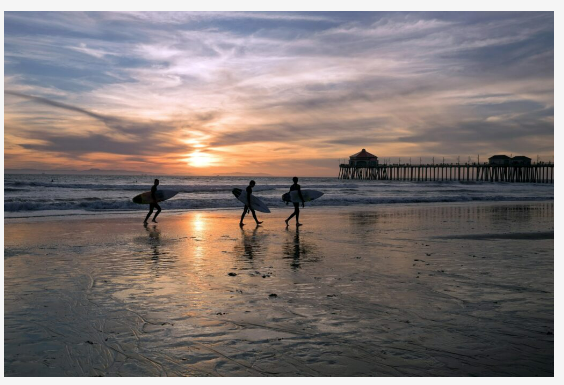
Huntington Beach is a seaside city within Orange County in Southern California located along the Southern California Coast 35 miles south of Los Angeles and 90 miles north of San Diego.  It is bordered by the Pacific Ocean on the west, and has been long known for its long 8.5 miles of beautiful beach, mild climate, and excellent surfing, earning it the nickname of Surf City.  Surf, sand and sun perfectly encapsulate what the City of Huntington Beach is all about.  The ocean waves are enhanced by a natural effect caused by the edge-diffraction of open ocean swells around Santa Catalina Island. Swells generated predominantly from the North Pacific in winter and from a combination of Southern Hemisphere storms and hurricanes in the summer focus on Huntington Beach, creating consistent surf all year long, hence the nickname "Surf City".

Whether you're analyzing it from a marketing, spiritual, political, or historical perspective, the truth is that the United States has four cities calling themselves "Surf City": Huntington Beach, Santa Cruz, Surf City (North Carolina), and Surf City (New Jersey).

Huntington Beach, also affectionately known as "HB," offers 10 miles of sandy beaches which hold more than 50 surf contests each year, including the legendary US Open of Surfing.
HB offers some of the most consistent breaks in Southern California, including the iconic Southside and Northside Piers, where thousands of national and international champions have been crowned over the decades.

Huntington Beach is also home to the International Surfing Museum, the Surfers' Hall of Fame, and the Surfing Walk of Fame. Duke Kahanamoku, the father of modern surfing, was inducted in 1994.

Huntington Beach officially adopted the Surf City USA nickname in January 2008, after a long and tense trademark dispute between the Southern California city and Santa Cruz.
It all started in 1927 when a Northern California newspaper coined the moniker "Surf City" for Santa Cruz.  Years later, in 1991, Huntington Beach adopted the nickname "Surf City USA" to promote the city.  In 1963, Los Angeles duo Jan and Dean recorded "Surf City," a song co-written and sung by The Beach Boys' Brian Wilson.  Although the beach anthem specifies no precise location for that particular Surf City, apparently, they had Huntington Beach in mind, not Santa Cruz.  However, the Santa Cruz authorities and politicians replied, noting that surfing had been introduced in Mainland America at Santa Cruz' Steamer Lane. The city even got support from Hillary Clinton, who visited Santa Cruz while campaigning for her husband in 2002. "I've been told to say that not only is this the real 'Surf City,' but that only real surfers surf in Santa Cruz," said Clinton while visiting the Lighthouse Point in May 1992.
Huntington Beach was quick to answer, but the controversy spread, and Surf City, New Jersey, also entered the heated debate.

Confused? The truth is that the East Coast town had its name well established since 1899.
When you thought all arguments were already on the table, a new variable enters the quarrel - Surf City, North Carolina, a small town located on Topsail Island (its name has been on the map since the late 1940s).  

But as always, where there is blood, there's media. So newspapers and TV stations started fueling the discussion, and the conflict escalated to an international level.
Which town was the real Surf City?

In November 2004, and after getting positive feedback from internet-based surveys and public inquiries, the Huntington Beach Conference and Visitors Bureau filed applications to register the "Surf City USA" trademark.  Less than two years later, the United States Patent and Trademark Office confirmed three of the first Surf City USA trademark registrations.

Not happy with the outcome, and after being prohibited from selling products with the "Surf City USA" inscription, two Santa Cruz surf shop owners sued Huntington Beach for the public use of the term "Surf City."  A surf-off ensued.

Both parties eventually reached a confidential settlement with benefits for all sides, but the wounds were never completely healed.  The northerners still stick to the idea that they live in the spiritual home of American surfing; the southerners are proud of their historical surfing roots.

Interestingly, today, Huntington Beach has two nicknames. It is known as Surf City USA and, and since 2016, it's been officially labeled "The Soul of SoCal."

Surf City | The Timeline of an Iconic Nickname

1885: Surfing is introduced to Mainland America at the Santa Cruz river mouth;

1899: Long Beach City renamed Surf City, New Jersey;

1907: George Freeth is the first to surf Huntington Beach;

1927: A local newspaper coined the moniker "Surf City" for Santa Cruz;

1949: Surf City is an incorporated town in North Carolina;

1963: Jan and Dean record "Surf City," a song inspired by Huntington Beach;

1991: Huntington Beach adopts the nickname "Surf City USA";

2004: Huntington Beach files trademark applications for "Surf City USA";

2006: Huntington Beach and Santa Cruz reach an agreement over the use of "Surf City USA";

2016: Huntington Beach embraces a second nickname - "The Soul of SoCal";

Huntington Beach has a borderline semi-arid/Mediterranean climate, gradually changing for the second to the west and south due to its low precipitation. The climate is generally sunny, dry and cool, although evenings can be excessively damp. In the morning and evening, there are often strong breezes that can reach 15 mph.  Ocean water temperatures average 55 °F to 65 °F. In the summer, temperatures rarely exceed 85 °F.  In the winter, temperatures rarely fall below 40 °F, even on clear nights. There are about 14 inches of rain, almost all in mid-winter. Frost occurs only rarely, on the coldest winter nights. The area is annually affected by a marine layer caused by the cool air of the Pacific Ocean meeting the warm air over the land. This results in overcast and foggy conditions in May and June.

The California lifestyle is synonymous with Huntington Beach.  Dean Torrence, from the 1960’s pop group Jan and Dean, who co-authored the famous number one hit “Surf City,” said that Huntington Beach embodies the song’s spirit of freedom and California fun.  The city is also mentioned in the Beach Boys song “Surfin’ Safari” and in “Surfer Joe” by the Surfaris. Ocean swells, endless sunshine and a fleet of bobbing longboards have played an instrumental role in earning the city its well-deserved “Surf City” nickname.  Nothing epitomizes the California surf culture more than HB.  Boasting some of California’s widest, cleanest, and safest beaches, the unofficial dress code has become a mix of wetsuits, bikinis and sandals accessorized by volleyballs, surf boards and beach towels. 

Huntington Beach is one of the surfing capitals of the world, and that fact permeates every aspect of the city – from the Surfer Walk of Fame to the International Surf Museum, the sport is everywhere and provides a theme for much of the activities present there.  On any given weekend there is a surf competition of some sort happening.  We've even been there for some type of lifeguard competition which was pretty cool. 

George Freeth was the first person to surf in Huntington Beach with a demonstration on June 20, 1914. Freeth had been demonstrating surfing in southern California as a promotion for the city by Henry E. Huntington. Duke Kahanamoku started surfing in Huntington Beach in 1925 and helped popularize the sport. The first surfboard shop, which was located underneath the Huntington Beach Pier, opened in 1956 by Gordie Duane.

Apart from sponsored surf events, Huntington Beach has some of the best surf breaks in the State of California and that of the United States. Huntington Beach has four different facing beaches: Northwest, West, Southwest, and South. Northwest consists of Bolsa Chica State Beach with a length of 3.3 miles, the West consist of "The Cliffs" or "Dog Beach", Southwest is considered everything north of the pier which is operated by the City of Huntington Beach. South consists in everything south of the pier which primarily focuses on Huntington State Beach (2.2 Miles), which almost faces true South.

Bolsa Chica State Beach is operated by the California Department of Parks and Recreation and the Bolsa Chica State Beach Lifeguards. The beach is very narrow and the sand is very coarse. Bolsa Chica tends to have better surf with NW/W swells during the winter season. During the summer months the beach picks up south/southwest swells at a very steep angle. Due to the bottom of the beach, surf at Bolsa Chica tends to be slowed down and refined to soft shoulders. Longboards are the best option for surfing in the Bolsa Chica area.

"The Cliffs" or "Dog Beach" is also another popular surf spot. This segment of Huntington Beach is so named because dogs are allowed around the cliff area. Beach is very restricted and often is submerged with high tides. Surf at this location tends to be even bigger than Bolsa Chica during the winter and often better. During the summer most of the South/Southwest swells slide right by and often break poorly. The best option is to take out a longboard, but shortboards will do at times. Dolphins have also been sighted in this area.

Just north and south of the Huntington Beach Pier are some well defined sandbars that shift throughout the year with the different swells. Southside of the Pier is often a popular destination during the summer for good surf, but the Northside can be just as well during the winter. Around the Pier it all depends on the swell and the sandbars. Shortboard is your best option for surfing around the Pier.

South Huntington Beach, also known as Huntington State Beach, is where all the south swells impact the coastline. Huntington State Beach is operated by the State of California, Department of Parks & Recreation, and Huntington State Beach Lifeguards. This beach is very wide with plenty of sand. Sandbars dramatically shift during the spring, summer and fall seasons, thus creating excellent surf conditions with a combination South/West/Northwest swell. Due to the Santa Ana River jetties located at the southernmost end of the beach, large sandbars extend across and upcoast, forcing swells to break extremely fast and hollow. Best seasons for surfing at this beach is the summer and fall. The best option for surfing in this area is a shortboard.

The main thoroughfare of Huntington Beach, Beach Boulevard, was originally a cattle route for the main industry of the Rancho. Since its time as a parcel of the enormous Spanish land grant, Huntington Beach has undergone many incarnations. One time it was known as Shell Beach, the town of Smeltzer, and then Gospel Swamp for the revival meetings that were held in the marshland where the community college Golden West College can currently be found. Later it became known as Fairview and then Pacific City, as it developed into a tourist destination. In order to secure access to the Pacific Electric Red Car lines that used to criss-cross Los Angeles and ended in Long Beach, Pacific City ceded enormous power to railroad magnate Henry E. Huntington, and thus became a city whose name has been written into corporate sponsorship, and like much of the history of Southern California, boosterism.

The original Huntington Beach Pier was built in 1904 and was originally a 1,000-foot-long timber structure. Huntington Beach was incorporated on February 17, 1909, during the tenure of its first mayor, Ed Manning. Its original developer was Huntington Beach Company (formerly the West Coast Land and Water Company), a real-estate development firm owned by Henry Huntington. The Huntington Beach Company is still a major land-owner in the city, and still owns most of the local mineral rights. The company is now wholly owned by the Chevron Corporation.

At one time, an encyclopedia company gave away free parcels of land (with the purchase of a whole set for $126) in the Huntington Beach area. The lucky buyers got more than they had bargained for when oil was discovered in the area, and enormous development of the oil reserves followed. Though many of the old reserves are depleted, and the price of land for housing has pushed many of the rigs off the landscape, oil pumps can still be found to dot the city.

Huntington Beach was primarily agricultural in its early years with crops such as lima beans, asparagus, peppers, celery and sugar beets. Holly Sugar was a major employer with a large processing plant in the city that was later converted into an oil refinery.

The city's first high school, Huntington Beach High School, located on Main Street, was built in 1906. The school's team, the Oilers, is named after the city's original natural resource.
Meadowlark Airport, a small general-aviation airport, existed in Huntington Beach from the 1940s until 1989 and Huntington Beach Speedway, a racetrack designed for midget car racing, existed from 1946 until 1958.
The beach itself is also a lovely time and home to several classic beach activities . . . volleyball nets, fire pits, and beach-ready bike rentals, roller skating, etc.  There are a variety of restaurants available from quick bites on the beach to a "barrel trail" where you can discover 12 craft breweries, distilleries and tasting rooms https://www.surfcityusa.com/things-to-do/surf-city-usa-barrel-trail  Coach likes to stop at Bo's Bagels on Hamilton on our way to the beach.  Check out their signature sandwich, "The  Hamilton." https://bosbagelsandcoffee.com  I love their OJ.  If you're crunched for time, order on-line.  The Huntington Beach House is also fun and always has great music and drinks http://www.thehbhouse.com.  It's a good spot to relax in the big Adirondack chairs and people watch.  The Sahara Sandbar is a little further from the pier and looks cute too!  http://saharasandbar.com.  When we visited Kona a couple of years back we were turned on to Hawaiian shave ice and have found Hula Girls Shave Ice to be particularly refreshing after a long day in the hot sun.  https://my-site-100228-102576.square.site.  And then there's Duke's of course (named after Duke Paoa Kahanamoku, the Ambassador of Aloha).  The Sunday brunch is always busy You can also find a Duke's in Kauai, La Jolla (San Diego), Malibu, Maui and Waikiki https://www.dukeshuntington.com
There are also a couple of pet friendly restaurants if you have your furry buddy with you.  Sugar Shake Cafe on Main Street is a local hangout open for breakfast and lunch.  Surf City Ale House is on Main Street too and offers breakfast, lunch and dinner as well as outside seating.  
If the beach is too crowded and the sun's rays are a bit too bright for you, there are several hotels in the area with great cabanas to rent as well as children's programs.  The Hyatt Regency has three pools including a lagoon style pool and a children's water playground.  https://www.hyatt.com/en-US/hotel/california/hyatt-regency-huntington-beach-resort-and-spa/hunrh.  The Waterfront Beach Resort Hotel (a Hilton Hotel) offers your own personal butler, lounge furniture to accommodate up to 6, mini fridge and food to order.  https://www.waterfrontresort.com/ResourceFiles/pdf/dbc-wa-2020-brochure.pdf.  The Ninth Island at the Pasea Hotel & Spa offers day passes for visitors and locals looking to swim and recharge.  ps://www.paseahotel.com/beachfront-hotel-huntington-beach/pool-cabanas.  Sea Legs at the beach is technically located at Bolsa Chica State Beach but they have fire pits for rent as well as cabanas http://www.sealegsatthebeach.com/reservations
Named the "Best City to Live in Orange County" by the Orange County Register readers, Huntington Beach offers residents a charming community with ideal weather, a diversified economy overflowing with good jobs, a wide variety of housing, an excellent educational system, boat marinas, numerous parks, and exemplary health care.  Named for railroad magnate Henry Huntington who orchestrated its development, the city is now an epicenter of activity and entertainment with wide, sandy beaches.

Many of the events at Huntington Beach take place on the beach during the summer.  The city is often referred to as "Surf City" not for the height of the waves, but rather for the consistent quality of surf.  The U.S. Open of Surfing is featured on the south side of the pier. Huntington Beach is a stop on the AVP beach volleyball tour. A biathlon (swim/run) hosted by the Bolsa Chica & Huntington State Beach Lifeguards takes place in July, early at dawn. The race begins at the Santa Ana River Jetties and ends at Warner Avenue, Bolsa Chica State Beach. Huntington Beach Junior Lifeguard day camps are held which teaches pre-adolescents and adolescents ocean swimming, running, and first-aid medical knowledge.

Huntington Beach is also a popular destination for kite surfing, and this sport can be viewed on the beach northwest of the pier.

In addition to the beach-focused events, the Fourth of July parade has been held since 1904. The Huntington Beach Film Festival takes place every February.

The Pacific Airshow (originally known as the Breitling Huntington Beach Airshow, then the Great Pacific Airshow), featuring the Breitling Jet Team and the United States Air Force Thunderbirds, is held each October.

During the winter, the annual Cruise of Lights Boat Tour is held in the Huntington Harbour neighborhood. This is a parade of colorful lighted boats as well as boat tours to view the decorated homes. In February of each year since 1996, the Surf City USA marathon is held with over 20,000 runners.  The annual Kite Festival is held just north of the pier in late February.
Huntington Beach hosts car shows such as the Beachcruiser Meet and a Concours d'Elegance. The Beachcruiser Meet is held in March, attracting over 250 classic cars displayed along Main Street and the Pier parking lot.   A Concours d'Elegance is held at Central Park in June and benefits the public library. An informal "Donut Derelicts" car show occurs every Saturday morning at the intersection of Adams and Magnolia Street. A Cars and Coffee car meet is held each Sunday morning at Pacific City.
Surf City Nights is held every Tuesday night during the year. The Tuesday Surf City Nights is a community-spirited event that features a farmer's market, unique entertainment, food, kiddie rides and a carnival atmosphere. Surf City Nights and the Downtown Huntington Beach Art Walk are presented by the Huntington Beach Downtown Business Improvement District (HBDBID) and the City of Huntington Beach. The Tuesday night Surf City Nights event takes place in the first three blocks of Main Street from Pacific Coast Highway to Orange Avenue.
One of the best things about Huntington Beach is the parking situation.  Tons and tons of parking.  Last April and again this year we bought the California Explorer Vehicle Day Use Annual Pass for $195 which allows access at most state beaches in our area.  The pass pays for itself in a few trips since single vehicle/single day use is $15.00.  

Sunday, June 19, 2022

Notable Californians: A Series (Part 3)

 JOHN WILLIAM "WILL" FERRELL

On to one of my favorite actors, Mr. Will Ferrell.  I didn't realize he was from Irvine until I was sitting in the chair getting some balayage done to my hair one day and laughing with my stylist about great Saturday Night Live skits.  

Will Ferrell was born July 16, 1967 in Irvine, California, to Betty Kay (née Overman) a teacher who taught at Old Mill School elementary school and Santa Ana College and Roy Lee Ferrell Jr. who played saxophone and keyboards for the Righteous Brothers. His parents were both natives of Roanoke Rapids, North Carolina. They moved to California in 1964. Ferrell's ancestry includes English, German, and Irish.  As an infant Ferrell suffered from pyloric stenosis (a thickening or swelling of the pylorus — the muscle between the stomach and the intestines — that causes severe and forceful vomiting in the first few months of life) and had a pyloromyotomy to correct the condition. He has a younger brother, Patrick.  

When he was eight years old, his parents divorced. Ferrell said of the divorce: "I was the type of kid who would say, 'Hey, look at the bright side! We'll have two Christmases'." The divorce was amicable, and both parents were committed to their children. The biggest problem was his father's line of work. As a person in show business, his paychecks were never steady, and he traveled from home for months at a time. Growing up in this environment made Ferrell not want to go into show business and instead have a steady job.

Will first attended school at Culverdale Elementary and later attended Rancho San Joaquin Middle School, both in Irvine. He attended University High School in Irvine, and was a kicker for the school's varsity football team.  He was also on the soccer team and captain of the basketball team, as well as serving on the student council. Ferrell called third grade "a pivotal year." He realized he could make his classmates laugh if he pretended to smash his head against the wall, or if he tripped and fell on purpose, and said it was a great way to make friends. He said the dullness of Irvine contributed to the growth of his humor:

Growing up in suburbia, in safe, master-planned Irvine, there was no drama so we had to create it in our heads. My main form of entertainment was cracking my friends up and exploring new ways of being funny. I didn't have to have the survival mode instinct like other comics, who grew up in tough neighborhoods. I had the opposite. For me, I grew up in Mayberry, and the humor broke the boredom. And there was a lot to make fun of.

In his senior year of high school, Ferrell and a friend would perform comedy skits over the school's intercom system, with cooperation from the principal; the two had to write their own material. Ferrell also performed comedic skits in the school's talent shows. He was voted "Best Personality" by his classmates.  He enrolled at the University of Southern California, where he studied sports broadcasting and joined the Delta Tau Delta fraternity. In college, he was known for a few pranks. On occasion, he would dress in a janitor's outfit and stroll into his friends' classes. He was also known for streaking around campus with a few other people from the Delta Tau Delta fraternity.  Ferrell earned an internship at a local television station in the sports department, but he did not enjoy the work.

After graduating with a B.A. degree in sports information in 1990, he knew he did not want to do broadcasting. He took up a job as a hotel valet where, on his second day, he tore a baggage rack off the top of a van by trying to drive it under a low beam. He also worked as a teller at Wells Fargo, but came up short $300 the first day and $280 the second; he was not stealing the money, but was just careless and error-prone. In 1991, encouraged by his mother to pursue something he liked, Ferrell moved to Los Angeles. He successfully auditioned for the comedy group The Groundlings where he spent time developing his improvisation skills.

He first established himself in the mid-1990s as a cast member on the NBC sketch comedy show Saturday Night Live, where he performed from 1995 to 2002, and has subsequently starred in comedy films such as Elf (2003), Anchorman: The Legend of Ron Burgundy (2004) Kicking & Screaming (2005), Talladega Nights: The Ballad of Ricky Bobby (2006), Semi-Pro (2008), and Land of the Lost (2009). He founded the comedy website Funny or Die in 2007 with his writing partner Adam McKay. Other notable film roles include The Other Guys (2010), The Campaign (2012), Get Hard (2015), Holmes & Watson (2018), and the animated films Curious George (2006) and Megamind (2010).

Ferrell is considered a member of the "Frat Pack", a generation of leading Hollywood comic actors who emerged in the late 1990s and the 2000s, including Jack Black, Ben Stiller, Steve Carell, Vince Vaughn, Paul Rudd, and brothers Owen and Luke Wilson. He received an Emmy Award nomination for his work on Saturday Night Live, and three Golden Globe Award nominations for acting in The Producers (2005) and Stranger than Fiction (2006) and for producing Vice (2018). He was also named the best comedian of 2015 in the British GQ Men of the Year awards. Ferrell received a star on the Hollywood Walk of Fame on March 24, 2015.
One of my favorite Will Ferrell skits, The Spartan Cheerleaders with Cheri Oteri, first aired November 11, 1995.  Although Craig and Arianna didn't make the East Lake High School Spartan cheer squad, they decided to cheer on the sidelines anyway showing up at various school events.  Their  school spirit and enthusiasm was infectious.   


Brothers Doug and Steve Butabi (Chris Kattan and Will Ferrell respectively) were habitual clubbers dressed in bad rayon suits who attempted to pick up women on their outings. Their trademark was bobbing their heads in unison to the song "What Is Love" by Haddaway, which always played throughout the duration of each sketch. The brothers were extremely unfortunate with the women at the clubs, often gyrating against them in an attempt to get them to dance, but always causing a negative reaction. They were frequently joined by a third person, often the host, who dressed and acted in a similar fashion (notably Tom Hanks, Jim Carrey, Sylvester Stallone, Martin Short, and Alec Baldwin); this character was usually credited as "Barhop". Skits starring Pamela Anderson and Cameron Diaz were also featured. The sketch spawned the 1998 film A Night at the Roxbury.  The Roxbury Guys premiered on March 23, 1996.  

SNL is famous for its presidential (an presidential hopefuls!) impersonations.  One of my favorites is Will's version of GW Bush.  Ferrel perfectly balances the former president's attempt at formality and seriousness while coming off goofy and loveable.   

One of the best Christmas movies ever made.  Hands down.  

"More Cowbell" is a comedy sketch that aired on Saturday Night Live on April 8, 2000. The sketch, which fictionalizes the recording of the song "(Don't Fear) The Reaper" by Blue Öyster Cult, features guest host Christopher Walken as music producer Bruce Dickinson and cast member Ferrell, who wrote the sketch with playwright Donnell Campbell, as fictional cowbell player Gene Frenkle, whose overzealous playing annoys his bandmates but pleases producer Dickinson. The sketch also starred Chris Parnell as Eric Bloom, Jimmy Fallon as Bobby Rondinelli, Chris Kattan as Buck Dharma and Horatio Sanz as Joe Bouchard.
An episode of VH1's Behind the Music documenting the band Blue Öyster Cult showcases footage of the group from a 1976 recording session that produced the band's biggest hit, "(Don't Fear) The Reaper". The producer (played by Christopher Walken) introduces himself as "The Bruce Dickinson" and tells the band they have "what appears to be a dynamite sound". The first take seems to go well but the band stops playing because the cowbell part is rather loud and distracting. Dickinson, to the surprise of most of the band, asks for "a little more cowbell" and suggests that the cowbell player, Gene Frenkle (Will Ferrell), "really explore the studio space this time". Frenkle's exuberance in following this advice causes him to bump into his bandmates as he dances around the cramped studio, thrusting his pelvis wildly in all directions, and the band aborts another take.
Frenkle sheepishly agrees to tone down his performance in the spirit of cooperation. He passive-aggressively plays the cowbell very close to Eric Bloom (Chris Parnell)'s ear and fails to keep time with the rest of the band. The rest of the band expresses frustration with Frenkle, but Dickinson remains focused only on getting more cowbell onto the track. Frenkle makes an impromptu speech to the rest of the band, declaring that Dickinson's stature lends a great deal of weight to his opinion about the cowbell part and that the last time he (Frenkle) checked, they didn't have "a whole lot of songs that feature the cowbell" and therefore he would be "doing himself a disservice, and every member of the band" if he "didn't perform the hell out of this". In the end, the band agrees to let Frenkle play the cowbell part his way. The sketch ends with a freeze frame on Frenkle with the superimposed message: "In Memoriam: Gene Frenkle: 1950–2000."

Will Ferrell's idea for the sketch came from hearing "(Don't Fear) The Reaper" over the years: "Every time I heard [the song], I would hear the faint cowbell in the background and wonder, 'What is that guy's life like?' He co-wrote the sketch with friend and playwright Donnell Campbell. Ferrell first submitted it for the episode with Norm Macdonald as host, which aired on October 23, 1999. SNL creator and executive producer Lorne Michaels was unsure about the premise, though the sketch played well among crew at the table read. According to Seth Meyers, who served as head writer several seasons later, the sketch was submitted over seven times before making the show. Ferrell re-wrote the sketch when Christopher Walken was scheduled to host to fit the actor's rhythm.
The actors who appeared in the sketch had trouble keeping straight faces. They found Ferrell's acting, along with Walken's stone-faced performance, so funny that they were all on the verge of corpsing (breaking character) and ruining the sketch several times. On "Take Two", Walken can be seen through the booth glass, laughing, as Ferrell's too-tight shirt rides up, exposing Ferrell's stomach while he is dancing and playing the cowbell. Even Ferrell at one point can be seen laughing for a moment soon after Jimmy Fallon laughs for the first time in the sketch. According to Ferrell and Michaels, the sketch did not do well in dress rehearsals, and Ferrell had the idea of performing in a smaller shirt in the live sketch. According to Fallon, Ferrell's tighter shirt made him unable to stop laughing, and had to bite his drumsticks to avoid breaking the scene.
"More Cowbell" is often considered one of the greatest SNL sketches ever made, and in many "best of" lists regarding SNL sketches, it is often placed in the top ten, being ranked number nine by Rolling Stone.  As a result of its popularity, "more cowbell" became an American pop culture catchphrase and has even entered the dictionary.  


Monday, June 13, 2022

SoCal Beaches: Laguna

We quickly learned that each of the beaches in Orange County / Southern California all have geological peculiarities which lend to each beach's distinct vibe.  Newport is "yachty" to me and Laguna is "artsy."  And I love it.  It's my favorite beach town in Orange County.  And no, I never watched The OC or the Hills or any of those shows.  
Laguna Beach
The artist colony of Laguna Beach is one of Orange County’s hidden gems, located halfway between Los Angeles and San Diego. The city’s topography is unique to other California coastal cities with its seven miles of coves and majestic canyons where visitors can explore sea caves, tide pools, ocean side bluffs, natural tide pools and of course, sandy beaches, all within city limits. 
Beyond the beach, the city is home to more than 20,000 beautiful acres of protected wilderness, making it an optimal location for adventurous exploration. From world-renowned mountain biking trails for all levels of expertise, hundreds of miles of hiking, dramatic vistas, verdant hills and marine sanctuaries, there’s no limit of new places to discover during a visit to Laguna Beach. 
Renowned as an artists' colony for over 100 years, Laguna Beach is the epicenter of SoCal cultural life. Home to more than 70 independent galleries, 400 working artists, 100 unique works of public art, and a diverse range of festivals  throughout the year, it's a great place to get involved in the local art scene. 
The city, picturesquely situated among stunning cliffs, coves, and canyons, developed as a coastal resort and art colony, and it now draws millions of visitors annually. The Festival of Arts and Pageant of the Masters is held at Irvine Bowl, a natural amphitheater just east of the city; held nightly in July and August, the pageant re-creates contemporary and classical artworks with elaborate sets and people posing to resemble characters in the original art, accompanied by a live orchestra. Other notable local attractions include the Laguna Art Museum, formed from the Laguna Beach Art Association (founded 1918), and several arts festivals.
Pick up a free map from the Official Visitors Center (381 Forest Avenue) and take a self-guided tour to explore its numerous sculptures.  First Thursdays Art Walk is a free festive, cultural evening that runs from 6-9pm on the first Thursday of every month. Visit more than 40 galleries and Laguna Art Museum for free - and make the most of the city's complimentary trolley service.

Easily get from point A to point B using the free Laguna Beach open air trolley which runs every Friday (4pm-11pm), Saturday (11am-11pm) and Sunday (11am-8pm) from September through June; and 9:30am-11:30pm during the summer months (July and August).  Download the VISIT LAGUNA BEACH APP for a real-time Trolley Tracker.
Luring artists, beachgoers and water sports enthusiasts, Laguna Beach is known for its diverse beauty and culture. The city's beaches draw six million visitors annually, with each of them having their own personality and specializing in its own activities. Check out these nine coves and beaches along Laguna's seven miles of coastline, which offers 30 to explore. Soak up the sun, kayak, venture out on a whale watching or dolphin excursion, and discover native habitats of sea life that call Laguna Beach home. Part of the Mexican land grant (1837) called Rancho San Joaquin, it was named Lagona, a corruption of the Spanish word meaning “lagoon,” for the two lagoons at the head of Laguna Canyon. Founded in 1887 as Lagonas, it was renamed Laguna Beach in 1904.
Heisler Park is a large oceanfront park that provides access to several beaches, including Picnic Beach and Rockpile Beach, both of which are located on either side of Monument Point at the center of the park. The park also provides access to Diver’s Cove and Main Beach, located on opposite ends of the park.
The park was named after Howard G. Heisler, who bought the property in 1905. It contains art sculptures and offers many amenities, including paved walking paths, large grass lawns, picnic tables, charcoal grills, a gazebo, outdoor showers (at the bottom of the stairways leading to the beaches), bathroom facilities, and, of course, the beaches, where you can lay out on the sand, explore coves or go tide pooling.
Also included within the park is a veterans memorial that was presented by the American Legion Post 222. The Veterans Monument includes two plaques that commemorate the memories of those that gave their lives to protect our freedom, as well as those that served in the armed forces during time of war. The monument also contains a time capsule that was sealed up in 1977 and is scheduled to be opened on May 30, 2027.
The park is located on Cliff Drive, just one block off of the Coast Highway. Turn onto Myrtle Street, which will run directly into Cliff Drive, which has lots of on-street metered parking spaces.  When visiting, consider eating at Las Brisas which serves seafood inspired dishes  (please refer to my previous post about SoCal Dining!).  The restaurant, is located at the south end of Heisler Park and overlooks downtown Laguna and Main Beach. If you plan to spend more than a day in Laguna Beach, consider the elegant Laguna Cliffs Inn or the upscale Inn at Laguna Beach.

Picnic Beach is the northern beach of Heisler Park. The park above the beach offers grassy areas to spread out on and many picnic tables as the name suggests. Scuba diving is popular at Picnic Beach and the adjacent cove to the north called Diver’s Cove. Tidepooling is also popular here when tide pools are exposed at low tide at the south end below the Laguna Beach Lawn Bowling Club. Picnic Beach is a wider sandier beach than Rockpile Beach which can be found in the cove just around the corner toward Laguna’s Main Beach.
Rockpile Beach is the southern beach of Heisler Park.  Rockpile Beach is in a south-facing cove with rocky outcroppings at each end. At high tide this narrow beach nearly disappears, but when the tide is out excellent tide pools are exposed. Bird Rock is a large rock offshore at the east end of Rockpile Beach. Beyond this eastern point is the Main Beach of Laguna Beach. Access to Rockpile Beach is easiest at the middle of the cove from the park near Jasmine Street. There are also stairs to the western end of the cove near the Laguna Beach Lawn Bowling Club. On the other side of this point is Picnic Beach. Parking can be found along Cliff Drive all along Heisler Park. Note that swimming is not permitted at Rockpile Beach because it is a designated surfing area.
Diver’s Cove Beach is at the west end of Heisler Park near downtown Laguna Beach.  The beach is right below and just east of the Divers Cove Condominium building. A public stairway access can be found adjacent to the building.  As the name indicates this is a great cove for scuba diving with reefs just offshore. The rocky point that supports a large condo building provides Diver’s Cove Beach some protection from the west although rip conditions still make swimming dangerous at times.
Main Beach is a nice sandy beach in a broad cove that faces southwest. Main Beach has a grass park located where Broadway Street (Hwy 133) tees into South Coast Highway (Hwy 1) in downtown Laguna Beach. I love hitting Main Beach as you come through the canyon.  The park offers a boardwalk, basketball courts, sand volleyball courts, a play area for children, and a wide sandy beach for getting your tan on.  Lifeguards look on from a tower near the middle of the beach. After it rains a creek appears out of nowhere and will flow out from under the park and cross over the sand. Rip currents can develop here so be careful swimming. Surfing is not allowed in the summer months. North of Main Beach is Heisler Park which has tide pools and south is a long stretch of connected beaches starting with Sleepy Hollow Beach that can be walked at low tide. Metered street parking is available along Highway 1 and the many side streets.  Filled with people walking along the boardwalk eating ice cream or gelato, sunbathers marking their spot in the sand, kids playing on the jungle gym and splashing in the waves, beach volleyball games hitting the sand and basketball players jumping on the court for a pickup game, this is the place to people watch. 
If you are looking for a good launching site to go kayaking, Crescent Beach provides mostly calm waters for an easy send-off. On the water is where action is found: the likelihood of seeing seals, sea lions and dolphins up close is high. Put your phone in a waterproof case to capture the action, but make sure you keep a little distance to avoid disturbing the animals' natural habitat.
Head to Aliso Beach-fire pits set up along the sand are perfect for a hangout with your closest friends or family, just steps from the waves. Bring a cooler, some blankets and don't forget the s'mores! Make sure you claim a pit early, as they are first-come, first serve, and fill up fast. If you don't, join in on someone else's fun. It's a great way to meet new people and party together!
Wood's Cove is a local favorite, lined with beach houses and rich in history. It's tucked away below the cliffs and hard to find when the tide is high. A great beach to get in tune with the Laguna Beach lifestyle, this stretch of sand is cozy, and can be completely covered in ocean water during high tide. When the tide is low, the magic of the cove reveals tide pools, tunnels and caves to explore. Find free parking off Diamond Street, carry in your picnic, and bring some water shoes for venturing over the rocks and wading until the tide comes in.
Shaw's Cove is one of the most secluded coves in Laguna Beach. Round up your snorkel gear and take a dive in this oceanic pool to take in the beauty of colorful creatures living under the sea. Locals know that the north side is the place for underwater structures and beautiful plant and sea life. Expect to see garibaldi (the most common), perch, rockfish, and sandbass. Take note that this beach is very rocky and sand is limited for the sunbathers.
If you are a newbie when it comes to surfing or want a good lesson to teach you the fundamentals, Thalia Street Beach is for you. Just off Pacific Coast Highway (PCH), find surf shops that offer rentals and lessons. You can partake in a group or private lesson to learn the ropes and enjoy a day spent out in the water. There is plenty of beach to dry off on post-wave catching.
Closer to Kelly Slater surfing skills? Head to Rockpile. Be mindful, this is typically a "surf only" beach with rocks lining the break and hiding underneath the waves. If you are in the water, make sure you are experienced with this sport, as the waves pop up and curl fast. If you are a spectator, grab a beach chair, but be watchful for incoming waves that can sneak up and soak you. If you want to stay dry and get a great view, head up to The Deck, a casual beachfront restaurant and bar, to grab a drink and watch the action. The swells vary per day; you won't always see monster waves come crashing in, but when they do, they are a treat
Spend a day on the hidden beach at Treasure Island, accessible only by climbing over rocks or swimming around a craggy headland, and you might find yourself glancing over your shoulder, longing for a one-legged buccaneer with a parrot to wade up on shore. 
Nowhere is the town’s pirate mystique so potent as on Victoria's Beach. It’s easy to imagine an 18th century scalawag guzzling tankards of rum on the sand after burying a chest brimming with gold. There, battered by the unending cycle of tides, stands a lonely stone turret—affectionately called the “Pirate Tower” by locals. The tower is sixty feet tall and seems to have been birthed directly from the sandstone cliffs that surround it. For residents and visitors alike, the sight of the structure and its small, unevenly shaped windows launches visions of retired freebooters keeping their weather eyes peeled for the sight of the Jolly Roger on the horizon. 
Victoria Beach is hidden down a long staircase, which lies under a canopy of trees in a small neighborhood that can easily be missed as you are cruising down PCH. At the north end of the beach, find one of the most mysterious structures in Southern California: La Tour (also referred to as Victoria Tower), a castle-style tower built at the base of a cliff. The tower houses an enclosed staircase to the beach from a private residence up on the bluff. Needless to say, the tower is a favorite spot for professional and amateur photographers as well as locals and visitors. HINT: Be sure to check the tide tables before your visit as the tower can only be accessed at low tide, and proceed with caution.

These surreal imaginings may not be based in fact, but research proves they aren’t pure fiction either. The tower’s origins aren’t particularly mysterious. It was built in 1926 as an enclosed staircase to the beach for William E. Brown, a senator from Los Angeles. After coming to California in 1882, Brown developed into an avid and acclaimed painter—making Laguna Beach a natural fit for his dream home. The tower was surely influenced by its owner’s aesthetic tastes and love of Laguna’s diverse geography. 
In the early 1940s, Brown sold his home to a retired naval captain, Harold Kendrick. Kendrick was a lifelong pirate aficionado and found himself attracted to the home because of the odd, slightly askew tower. Records call Kendrick as “eclectic and fascinating as the buildings themselves” and go on to describe how he would dress in pirate regalia and invite local kids over for games and stories of the sea. Winners of Kenrick’s puzzles and scavenger hunts received “cold cash”—the chance to grab a handful of money from a change bowl kept inside the refrigerator. The tower itself often made an appearance in Kendrick’s tales and children longing to buy candy knew to search its many cracks and crevices for slyly hidden coins. According to the Laguna Beach historic register, “finders were keepers.”
These days, the property has switched hands a number of times and the tower is kept under lock and key—a skeleton key, one hopes, pockmarked with flecks of rust. The stories of coins tucked between the stones are all but forgotten now. Still, as long as the tower is standing, it will inspire the imaginations of bold spirits young and old longing for the days of wild-eyed rogues sailing under the black flag. Note: The Pirate Tower can only be accessed at low tide. At the south end of this beautiful stretch of beach, there is one of the best places around for skimboarding. Grab your board and head to this hidden gem, to slip, slide and hang with the locals.
And lastly, don't miss a Laguna Beach sunset. Cress Street Beach is one of the best places to sit and watch as day turns to night. The colors and patterns that fill the sky are simply stunning-pink, orange, purple and more. Cress Street Beach also happens to be a romantic spot, with a bench located halfway down the stairs that's the perfect place to watch the waves come in. Afterward, head up to The Rooftop Lounge for a cocktail atop the hotel La Casa Del Camino.

Total Pageviews

My Blog List

Some of My Favorite Quotes

"You know you're in love when you can't fall asleep because reality is finally better than your dreams." -- Dr. Seuss

"Nothing makes a woman more beautiful than the belief that she is beautiful." -- Sophia Loren


"There must be quite a few things a hot bath won't cure, but I don't know many of them." -- Sylvia Plath

“Life is too important to be taken seriously.” – Oscar Wilde

If people are truly, madly, deeply in love with each other, they will find a way.~Gilda Radner

“Never judge a day by its weather. Sunshine is uplifting; rain, nourishing; wind, exhilarating; snow, cleansing; hail, stimulating. Any weather is better than none.” -- Author Unknown

"Everything you see I owe to spaghetti." -- Sophia Loren

"I know I'm vulgar, but would you have me any other way?" -- Elizabeth Taylor

"After thirty, a body has a mind of its own." -- Bette Midler

"Cherish forever what makes you unique, 'cuz you're really a yawn if it goes." -- Bette Midler

“I know I can be diva-ish sometimes, but I have to be in control. The nature of my life, the nature of what I do, is divadom, it really is." -- Mariah Carey

"I want minimum information given with maximum politeness." -- Jackie Kennedy Onassis

"I've been called a diva, queen diva, diva supreme, and I love it. However, that's really for others to decide, not me." -- Aretha Franklin

"No one loves a party more than I. I am a people person." -- Aretha Franklin

"There are many little ways to enlarge your child's world. Love of books is the best of all." -- Jackie Kennedy Onassis
Blogging Resources for Women
 
Designed by Munchkin Land Designs • Copyright 2011 • All Rights Reserved