Showing posts with label NFL. Show all posts

Monday, October 7, 2019

Football is here. And it's Female!!!

Football is back baby and better than ever!  Ole Miss beat Arkansas this week but Coach's beloved (God Damn) Jets lost to the Bills 16-17 and will be holding a kicking try-out this week. 

Whether you watch your local pee-wee league, high school, college games on Saturday or the pros on Sunday, have you ever searched the sidelines looking for a female that wasn't a cheerleader or a trainer?  If you look hard enough, they're there.  And the numbers are increasing.  In communities across the country, the game is increasingly being played, coached and managed by women. And the NFL is helping those women get on the path to a career in the game they love.

Women account for nearly half of the NFL’s fan base, yet they make up just a third of league employees, according to CBS News. The league continues to be overwhelmingly male-dominated.  there has never been a woman head coach or general manager of an NFL team.  The NFL's struggle with its response to player protests and cases of domestic violence and sexual harassment are not a secret.  Now it's working to get more women working in the league.

Carolina Panthers head coach Ron Rivera has seen firsthand the battles with workplace misconduct. Panthers owner Jerry Richardson was forced to step aside, appointing Tina Becker as his replacement, now one of the NFL's top female executives. "There are jobs for women involved in the NFL and they're not on the outside, they're on the inside. They're making decisions," Rivera said.

Skeptics ask how can women coach when they've never played football? Well, some of the best coaches never played the game either. Representatives from other leagues, like Major League Baseball, are already turning to the NFL for advice on how to replicate this forum for their own sport.

Anne Doepner is a lifelong Minnesota Vikings fan – and one of the pioneers, rising from executive assistant to the team's director of football administration.  "I've been challenged about the fact that I want to do this job, to my face. You know, I've had people say, 'Why do you want to do this?'" Doepner said. "'And Why not?' is what I say back. … I think that a lot of women think that, that it's not a possibility or not something they would naturally consider doing because they don't see other women doing it."


Phoebe Schecter
Phoebe Schecter, like many of the women involved with the NFL, played tackle football. After attending the two-day NFL forum in 2017 where women are learning the finer points of coaching, scouting players, and the importance of dreaming big, she landed an internship with the Buffalo Bills.

"It makes you so confident, playing this sport. And you feel empowered. And then you get to come to somethin' like this and you've got these other women who experience the same things. And you just think, I can conquer the world after this," Schecter said.

She is an American and British citizen. She says "soccer" but also has an endearing twang to her Connecticut accent when she mentions her Northern "gran". She stands at a petite 5ft 3in and plays swash-buckling linebacker for her American football team. She is a woman and she has coached in the NFL. She grew up in the USA, but she did not fall in love with its (unofficial) national sport until she moved across the Atlantic.

She is one of just three women to ever coach in the NFL, but Schecter says she was much too busy with horses for the first 23 years of her life to ever get caught up in the sport that produces the world's most lucrative league.

"Horses is a 24/7 thing, it's all encompassing. I never had an interest in football. Equestrian was what I'd always done, it's what I thought I'd spend the rest of my life doing."  It was only when she moved from Connecticut to Cheshire, England to work for a member of the Dutch Olympic equestrian team that Schecter's head was turned.

"I worked six days a week, on my one day off I thought it would be good to meet people. I saw an ad on Facebook for American football and took the chance. It was the best decision I ever made.
"I had no idea what I was doing, I had zero body control. But the girls I met that day were what brought me into it more - and that I got to hit people."

In the past six years she has dropped her lifetime horse habit and replaced it with her newfound "addiction" - contact sports. As a defensive linebacker, Schecter's position involves some of the hardest hitting in the game. It is one of her favourite elements though, and she even plays in a mixed full-contact American football league where she is the only woman on her team, getting tackled by and tackling men twice her size.

"You get two types of [men] - those that say 'She's a girl, she shouldn't be here,' and they come for you, or who don't want to hit me because I am a girl," she says laughing.

She also did strength and conditioning coaching for the sport's Great Britain association and helped develop the women's team on their rise to fourth-best in the world. And, thanks to her dual citizenship, she will captain the team at this week's European Championships in Leeds alongside all self-funded teammates and volunteer coaches.

Schecter is also England captain in kabaddi, an invasion game popular in Asia which she compares to British bulldog with tackling. Watch Youtube highlights of the aggressive low tackling - or "carnage" as Schecter puts it - makes the appeal clear.
But of Schecter's wide-reaching sporting achievements, her most prolific was becoming one of a handful of women to coach in the NFL, starting with a Buffalo Bills coaching internship in 2017. A remarkably quick turnaround for someone who never even cared about American football until 2013, no? But upon meeting the charismatic 29-year-old it becomes obvious how she managed such a rise.

It is unsurprising that upon applying to five NFL teams via a diversity internship scheme, she had to turn down offers before taking up the Bills position. That two-week summer camp pushed Schecter right into the deep end. "It's very daunting. These guys know so much more than me about football, I was working with the defence team, and the head coach said, 'How do we get the players to respect you?'  "So he took my highlight reel and showed the guys. They were like, 'That's sick, she's better at tackling than us,' and since then they've been so supportive, some sending over videos for our GB teams wishing them good luck."  

But for all her enthusiasm, Schecter was plagued by self-doubt during her first tenure with the Bills and had to find ways to negotiate an imposter syndrome brought on by foreign football jargon and being the only woman on the sidelines. "At first it was a little rocky. It was an incredible opportunity and I kind of felt like other people who had been involved in the sport for much longer deserved that more than me. But I figured if I could just get all the little things down, even something as simple as if one of the guys asks me what time this meeting starts I would have the answer for them and they would start coming to me every time. It seems really minute, but when you can build up trust like that it's huge."

What has followed since - a season-long internship at the NCAA Division One college programme at Bryant University (where she slept in the head coach's basement and worked for free), consultancy work with NFL UK and even a full season at the Bills for the 2018-19 campaign - shows she must have made an incredible impression during that life-changing fortnight.

The Bills are off to a winning start to the season but Schecter will not be joining them after the European Championships. Instead, she is taking a self-imposed sabbatical in order to fully commit to developing the game in the UK.  A bold move some would say, but Schecter is as excited talking about her work with the UK Dukes, an organisation aiming to increase grassroots participation (with Schecter taking a special interest in female growth), as her time with the Bills.
"I've had a crazy moment in my life and I'm staying here for the season. [The Bills] are being so supportive.  "From day dot my underlying goal has always been bridging the gap between the US and UK. I thought it was the best time to see what I can do to help."The European Champs should be a huge opportunity for this country to see what we're doing with this sport. There's lots of positive things going on now for women in the sport, we need to ride the wave."


Charlotte Jones-Anderson
Charlotte Jones-Anderson is the Dallas Cowboys' Executive Vice President and Chief Brand Officer. Anderson was appointed Chairman of the Salvation Army’s National Advisory Board in 2010 and is the first woman to ever serve in that role.  In 2012, Anderson was named Chairman of the NFL Foundation and is responsible for spearheading philanthropic efforts in player care, youth football, and medical research. Anderson is the first woman to serve in this capacity for an NFL charitable institution, and the first woman to represent club ownership as leader of a major professional sports league foundation.  In March 2013, Charlotte Jones Anderson won the Individual Arts Patron Award at the Texas Medal of Arts Awards. In September 2013, Anderson was named one of SportsBusiness Journal 2013 Game Changers as a Team Leader.  Under Anderson’s guidance the Dallas Cowboys Cheerleaders were awarded The American Legion Distinguished Service Medal, the American Legion’s highest honor, for their dedication to community service and support for the United States military.  In March 2017, Anderson was inducted into the Arkansas Sports Hall of Fame for Football Administration.


 Welter, Javadifar and Locust
The Tampa Bay Buccaneers became the first NFL team to have two women as coaches on its staff, announcing the hiring of Maral Javadifar as assistant strength and conditioning coach and Lori Locust as assistant defensive line coach.  Locust and Javadifar are the first full-time female coaches in Buccaneers' franchise history.  "I know how hard it can be to get that first opportunity to coach at the highest level of professional football," Arians said.  "Sometimes, all you need is the right organization to offer up the opportunity. The Glazer family and our general manager, Jason Licht, were extremely supportive of my decision, and I know Maral and Lori will be great additions to my coaching staff.

"I have known Lori going back to my days at Temple University and I've seen firsthand just how knowledgeable and passionate she is about this game. I was equally impressed with Maral's background in performance training and physical therapy and I know she will be a valuable asset to our strength and conditioning program." 
 
Locust comes to the Buccaneers after working as the defensive line coach for the Birmingham Iron of the Alliance of American Football during the league's inaugural season this spring. In 2018, Locust was a defensive coaching intern for the Baltimore Ravens during the team's training camp and, from 2017-18, worked as a defensive line/linebackers coach and co-special teams coordinator of the Lehigh Valley Steelhawks of the National Arena League.

Javadifar most recently worked as a physical therapist at Avant Physical Therapy in Seattle, after completing her Sports Physical Therapy Residency at Virginia Commonwealth in 2018. Prior to her time at VCU, Javadifar worked as a physical therapist and performance trainer in Virginia, while also serving as a guest lecturer at George Mason University.


In 2015, Jennifer Welter served as an intern for the Arizona Cardinals, working six weeks over the summer as an assistant coach under linebacker coach Bob Sanders. She was the first woman to hold such a role on an NFL coaching staff.  “I think it’s time,” then-head coach Bruce Arians said.  “I am not afraid to step out and be different. Jen is a quality coach. She has earned this. I think she can help our players get better.” 

In an October 2017 interview Welter says one of the keys to her success in football has been male mentors who believed in her potential. “When you’re the first woman, and there’s no women in the room,” she says, “a man has to open the door for you. And that’s when it really has to be about progress and working together. Because if it’s not in alignment, it’s going to be a really tough process.”

In her stint in the NFL, Welter worked with the Cardinals' inside linebackers and coached throughout training camp and the preseason as a training camp/preseason intern. She's currently an assistant with the Atlanta Legends in the Alliance of American Football.


Kathryn Smith
During the 2016-2017 season, Kathryn Smith became the first woman to hold a full-time coaching position in the NFL. She worked as a Special Teams Quality Control Coach for the Buffalo Bills, where she helped to formulate game plans and build playbooks for the team. Smith held that position for one season under then-head coach Rex Ryan.  Smith has said it's crazy to hear that she was the first woman in that position because “you don’t set out to be a trailblazer, and I didn’t know that that’s where my path was going to lead me.”

Before stepping into her history-making role, Smith worked under Ryan when he was head coach of the New York Jets as a game-day/special events intern in 2003, reports ESPN. In 2005, she became a college scouting intern for the team, and then a player personnel assistant for the team in 2007. In 2014, Ryan appointed her to an administrative assistant position, a job she also held in 2015 when Ryan moved over to the Bills.  Smith began interning for the New York Jets while attending St. John's, becoming a game-day/special events intern in 2003 and then a college scouting intern in 2005. She became a player personnel assistant in 2007. She then became an administrative assistant in 2014 and joined the Bills as an administrative assistant in 2015. The Bills promoted her to special teams quality control coach on January 20, 2016, replacing Michael Hamlin. She was the first woman to be a full-time coach in the NFL. After the dismissal of Rex Ryan, Smith was not retained by new coach Sean McDermott heading into the 2017 season.

Smith grew up in DeWitt, New York, a suburb of Syracuse, and attended the Christian Brothers Academy. At CBA she participated in lacrosse, swimming, and bowling.  After graduating from CBA in 2003 she went to St. John's University in New York City.  Smith majored in Sport Management and served as a student manager of the men's basketball team.  Smith graduated from St. John's in 2007.


Katie Sowers
Katie Sowers became the NFL’s first openly gay and second full-time female coach, reports ESPN. Sowers, 31, works as an offensive assistant coach for the San Francisco 49ers, making her the team’s first female assistant coach. 

Sowers (born 1986) is an offensive assistant with the San Francisco 49ers since 2017. Sowers began her American football career playing in the Women's Football Alliance. Upon her retirement, Sowers joined the National Football League in 2016 as a coach for the Atlanta Falcons's training camp. Upon joining the 49ers in 2017, Sowers became the first LBGT coach in the NFL when she publicly came out before the 2017 NFL season.

In 2016, Sowers worked with coach Kyle Shanahan when he was an offensive coordinator for the Atlanta Falcons, according to ESPN. Before that, she played pro football for the Women’s Football Alliance and was chosen to compete for the national team in the Women’s World Championship.

Sowers was born in Hesston, Kansas. During her childhood, she started playing American football at the age of eight. For her post-secondary education, Sowers attended Hesston College and Goshen College in the 2000s before resuming her studies at the University of Central Missouri in the 2010s. In Central Missouri, Sowers graduated with a kinesiology master's degree in 2012.

While completing her studies at Goshen, Sowers began her American football career playing for the West Michigan Mayhem and the Kansas City Titans in the Women's Football Alliance. While with the Titans, Sowers was a member of the United States women's national American football team that won the 2013 IFAF Women's World Championship. Sowers continued to play in the WFA until her 2016 retirement due to a hip injury. Sowers joined the National Football League as a wide receivers intern with the Atlanta Falcons in the summer of 2016. After her summer position ended, Sowers remained with the Falcons as an intern scout until she moved to the San Francisco 49ers in June 2017. With the 49ers, Sowers resumed working as a seasonal offensive assistant until her promotion to offensive assistant in 2019.

“There are so many people who identify as LGBT in the NFL, as in any business, that do not feel comfortable being public about their sexual orientation,” she said. “The more we can create an environment that welcomes all types of people, no matter their race, gender, sexual orientation, religion, the more we can help ease the pain and burden that many carry every day.”


Kelsey Martinez
In 2018, Kelsey Martinez became the Oakland Raiders’ first female assistant coach in the franchise’s history. However, changes to the Raiders’ coaching staff for 2019 include the apparent departure of the first female assistant in franchise history.

Martinez, a strength and conditioning assistant, is no longer is listed as with the organization according to the team’s website. She joined the club in early 2018 under Tom Shaw, the department’s then-coordinator who was dismissed in December.

Martinez was well received within the organization. Special teams coordinator Rich Bisaccia was among those who considered her a barrier-breaking example.  “I have five sisters, and I have three daughters,” Bisaccia said in August. “For them to be able to, along with all other females, see that she’s accomplished this goal is going to give them a chance to realize, ‘Wow, this is a path I can take.’ … She carries herself extremely professionally. She’s incredibly knowledgeable in what she’s trying to teach these guys. She hasn’t missed a beat with the players." 

“Once a pro player feels like you’re knowledgeable and you can help them get better, they’re going to listen to you. And I feel like with Kelsey, that was evident right away, not only to the coaches but certainly to the players.”

In an interview with the Raiders’ website, running back coach Jemal Singleton talked about the positive impact that he hoped 26-year-old Martinez’s presence will have on his daughter.
“My daughter is five, so right now she’s at such an impressionable age that the sights and sounds she’s around will impact her really for the rest of her life,” said Singleton. “And to be in a situation here — I don’t know if it’s the first, or the only — but to get to have a female strength coach in Kelsey is unbelievable. Because now my daughter can see there’s so many different roles when you come here. You hear [play-by-play announcer] Beth Mowins on the call [during games], you see Kelsey out there working the players, and it’s one of those things as a father you want your daughter to have those aspirations to be whatever she wants to be.”


Callie Brownson
This isn’t the first time the Bills have been the NFL club that was taking a progressive step in diversifying their hiring practices on the football side of the house. The addition of Callie Brownson to their coaching staff as a full-time coaching intern this past week marks the third time in the last four years that a female is part of Buffalo’s coaching staff.

Brownson, a graduate of George Mason University, never had the opportunity to play football beyond the youth level, but played eight seasons as a safety, running back and slot receiver for the D.C. Divas of the Women’s Football Alliance. A five-time team captain, Brownson was a four-time All-American.
 
After coaching high school football in Northern Virginia for three years, Brownson attended the Manning Passing Academy where she served as one of 16 female coaches for the first women’s clinic. It was there she met Dartmouth head coach Buddy Teevens, who was impressed with her expansive knowledge base.  He offered her a two-week internship that turned into a full-time position as an offensive quality control coach, becoming the first full-time female football coach in Division I.
Coincidentally, after getting a similar two-week training camp internship with the Buffalo Bills this summer, her performance was such that again she was offered a full-year position on Sean McDermott’s staff.

“I first met Callie at the NFL Women’s Careers in Football Forum in Indianapolis through Buddy Teevens, the head coach at Dartmouth,” McDermott said. “She came highly recommended by him. I was immediately impressed by her enthusiasm for the game of football and her career aspirations. During training camp, she showed a tremendous work ethic and earned this opportunity. She is very driven, professional, smart, and eager to learn.”

There was always a passion for football within Callie Brownson. From watching games as a kid with her dad, to playing youth football and even women’s professional football. But coaching football beyond the high school level wasn’t given a second thought, until she witnessed the changes in diversity hiring in the NFL.

Mount Vernon high school, Brownson’s alma mater, was where she thought her coaching career would begin and end, under famed coach Barry Wells, who recruited her to coach on his staff.
“He was the one who bridged the gap,” said Brownson. “But even at that point I had coached with him for three years and I thought that was the pinnacle. I was going to work a nine to five job and then coach high school football and that was as good as it was going to get.”
 
That was until she saw the work that Sam Rapoport, the NFL Director of Football Development, and former pro football player herself, was doing to expand the avenue for women to land NFL coaching positions. “They made this big push for diversity including women more in their fan base and on the football side, Jen Welter gets hired. I had played on Team USA with her, so I knew her pretty well. So the wheels started to turn. Then you see the work that Sam Rapoport started doing from the NFL league office as it pertains to diversity and at least getting women in front of people or in the door, so I immediately jumped on that train.”

Brownson attended the NFL’s first ‘Women’s careers in Football Forum’ and even met Bills owner Kim Pegula.  “I remember she met about 200 people and I was toward the back of the pack and she still had that Kim personality,” Brownson said. “All these people meeting her and probably hitting her up for a job. So someone in her position would probably be exhausted. She was just Kim. She was super happy and reaches out and grabs your hand, asks her what you want to do. She left an impression on me because there were other people there who maybe weren’t as enthused.”  Networking and making connections at the forum ultimately led to her landing a personnel and scouting internship with the New York Jets.

Now with the Bills, Brownson is grateful that there were two females hired prior to her current tenure in Buffalo. Kathryn Smith was the first full-time female coaching hire of the Bills in 2016 when she was promoted to Special Teams quality control coach. Last season Buffalo hired Phoebe Schecter as a full-time coaching intern.

“It means a lot more and comes with a heavier punch to me to continue that,” said Brownson. “It means a lot to me for the two who came before me. Kathryn Smith and Phoebe Schecter both did an amazing job so that this could continue, so I could have this opportunity to be here. If they hadn’t done a good job it may have gone another way. What they’ve done and how hard they worked and the impression they left on people in this organization is the reason why I’m even here and have this opportunity to continue that.”

And Buffalo carried their female hiring over to their personnel department even before they added Brownson, hiring Andrea Gosper as a year-long paid intern in their scouting department this past April.

She was hired not long after meeting Bills GM Brandon Beane and Assistant GM Joe Schoen at the Women’s career in Football Forum in Indianapolis this past winter. It was there that Brownson first met Gosper, and now the two are working for the same NFL organization.  “Coach Teevens and I from Dartmouth actually spoke for the coaching breakout session. Andrea was in it and was a coaching intern at the University of New England,” Brownson said. “I met her there and she was somebody who came up to us and talked to us a little bit. I met her there and then I found out she got hired here. She’s incredible.”

As much as Brownson values her opportunity with the Bills, she just wants to get to work knowing the regular season is fast approaching. She knows that performing at her best every day will only help create more opportunities in the league for women going forward.

“I hope to continue it for someone else and leave a ripple effect among other teams as well,” said Brownson. “Here’s the third woman hired on our football staff and we’re going to keep doing this, and it has been successful for us, so you should do it too.”


Jennifer Stango Garzone
Sometimes, the football players on the opposing team would think the woman on the sideline was the manager. Or they would approach her — she had to be the trainer, right? — to tape up their ankles.

“I was like, ‘Sorry, guys, uh, you’ve got to go to the trainer, not me,’” said Jennifer Stango Garzone, the first female head high school football coach in the state. “It happened more so in the beginning and not so much now.”

Garzone, an assistant football coach for seven years at Wolcott Tech, became the head coach of MCW United in February after former coach Jamie Coty resigned. MCW United is a co-op team that encompasses Wolcott Tech in Torrington, Housatonic Regional High School in Canaan and Wamogo High in Litchfield.

“Football is probably always known to be not only a male sport, but kind of a man’s man sport — so for a woman to break the barriers down, so to speak … but Jen’s not your typical woman,” said MCW assistant Damian Gwinn, who has known Garzone for four years. “She played football. She knows the game. She’s not just some random person, that there was nobody there and she was the only one available to take the job. She was more than qualified for it.”

It’s not known how many female head high school football coaches there are nationally, but Garzone, 35, is not the first. There have been female head high school coaches in Colorado, Florida, Wyoming and Tennessee. Dartmouth hired Callie Brownson as an assistant as the first full-time female coach in Division I football, and since, Brownson has become a full-time coaching intern with the Buffalo Bills.

Brownson went through the NFL’s Women’s Careers in Football Forum; both the NFL and NBA have been making an effort to hire women in coaching positions.  “I think it’s fantastic,” said Karissa Niehoff, the executive director of National Federation of State High School Associations who was formerly the CIAC’s executive director. “Obviously, she brings semi-pro experience. Her knowledge of the game is superior. She commands respect from experiential perspective.”

Garzone played football for a number of years with women’s teams, including the Hartford-area Connecticut Crush and the Danbury Wreckers.  Seven years ago, she became an assistant football coach at Wolcott Tech, where she is a social studies teacher and the girls basketball and softball coach. Wolcott Tech football merged with the other two schools four years ago.

“For the most part, it’s been a smooth transition,” Garzone said at practice Thursday at Housatonic Regional. “I think having played and doing it for as long as I have, that question (of having a woman as a coach) isn’t there in the forefront of most of (the players’) minds.”

She had always liked playing football and thought about it in high school, at Sacred Heart High in Waterbury, but it was a backup plan in case she didn’t make the soccer team. Then she made the soccer team. She played soccer, basketball and softball in high school, then at Post University in Waterbury.

One of her soccer coaches told her about the Crush.  “She called me up and ‘Hey, do you want to come play football?’ and it was a done deal from there,” Garzone said on Thursday. “It was amazing. Just the sport itself, the camaraderie.”

She paused, watching the slower MCW players finish their mile run around the track.
“Hey, make sure you put pressure on who’s in your group to get them in because some of them are still walking,” she yelled. The players who had already finished started running with the others and encouraging them along.

“Coach, what group am I in?” one asked her.
“It’s like having 47 children,” said Garzone, who has a 4 ½-month-old girl with her husband Francesco Garzone, a math teacher at Wolcott Tech.
She laughed.
“Although I’m glad I didn’t give birth 47 times,” she said.
But does it feel like that some days? she was asked.
“Yes,” she said. “With no epidural.”
The players tower over her. To them, she’s “Coach.” Or “Stango.”

Eric Hickey, a senior wide receiver, said there’s no difference having a male or female head coach.
“We always have that mentality that we have to work hard and, hopefully, come away with the win,” he said. “I think it’s the same.”

The team hasn’t won since the merger in 2016. Wolcott Tech last won a game in 2014. So most days, she’s not thinking about being the first female coach; she’s thinking of what she will do to get the team its first win. MCW will host Platt Tech on Sept. 14 at Housatonic’s field.  “When you’re the first, the eyes are watching, the microscope’s on you. It is (pressure),” she said. “I try not to think about it too much and try to focus on the task ahead.

“The only saving grace is that I’m not taking over a state championship program. I’m taking over a team that’s still looking for their first win. That makes it a little easier, but the incentive is still there to do well.”

Anne MacNeil, Housatonic’s athletic director, loves having a female football coach.
“Having another strong female is amazing, and having Jen as the coach — she’s proven herself as a leader. She’s compassionate. She’s out here for our students — that was evident since day one,” MacNeil said. “It’s good for the boys. There has never once been any inclination of disrespect. She’s the coach.”


Loretha Douglas
Dedrick Sumpter already had a star-studded football coaching staff at Williamson High School in Mobile.
Former Auburn linebacker Antonio Coleman is defensive coordinator.
Former NFL No. 1 draft pick Jamarcus Russell is the passing game coordinator.
Sumpter’s most recent hire, however, may garner more respect and attention than either of those two Williamson legends.
Loretha Douglas has been a household name in park ball coaching in the city for nearly 30 years. She is now on Sumpter’s staff, coaching the defensive line and helping with special teams.
 
“Most people don’t understand what a legend she is in this city,” said Coleman, who played for Douglas when he was young. “She coached some of the best athletes ever to come through Mobile. In football, in basketball – she taught everything. She taught me how to play basketball.”

Douglas is one of two female football assistant coaches in the state entering the 2019 season. Geneva County’s Melissa Tomlinson is the other. They are believed to be the first female assistants in Alabama high school football history.  Sumpter and Geneva County head coach Jim Bob Striplin have said Douglas and Tomlinson weren’t hired as some kind of publicity stunt. They were hired based on their credentials and ability to coach young people.  “Publicity? If you are from this community, you know that is not what this is,” Coleman said.  “When coach Douglas first walks into this field house, I don’t care what size a kid is, they listen to her,” Sumpter said. “It doesn’t have anything to do with publicity. She’s very intense, but she has a deep connection to our players and most of our staff because she raised them all.”  That includes Coleman and Russell.

Douglas first became involved in coaching when the Boys and Girls Club of Mobile needed a physical education director in 1991. She worked there for 16 years before Hurricane Katrina destroyed the gym. She also spent time coaching at Harmon-Thomas Community Center and Taylor Park Community Center, among other stops.

She estimates she has coached more than 1,000 kids over the years and has even given a few a place to live when they needed it.  “Some of these kids were homeless or didn’t have anywhere to stay, and she would move them in her house and take care of them,” Coleman said. “Countless kids.”
When Sumpter became head coach at Williamson in 2012, he wasn’t familiar with Loretha Douglas.
That changed in a hurry.  “When I first got here, all I heard was, ‘Miss Lo, Miss Lo,’” he said. “I heard so much about her. Once we formally met, I would ask her every year, ‘When are you going to come join us? When are you coming? We need you.’”

The formal process for Douglas joining the Williamson staff started last fall.  “I had been laid off my last job,” she said. “I just sat around the house for about a month, just wondering what my next job would be. I finally heard a voice say, ‘Get up. Why are you just laying there?’ Coach Sumpter had been asking me to come coach. I finally told him that I would.” 
 
Douglas applied for a volunteer position with Mobile County Public Schools in October. Later in the fall, a full-time spot became available on the custodial staff at Williamson. Douglas jumped at that opportunity. It’s all been a smooth transition.
 
“I never planned any of it,” she told AL.com. “God just puts you in the right place at the right time.”
Coleman and Sumpter laughed at the thought that some of Williamson’s players might not respect Douglas because she is female.
 
Douglas graduated from Williamson in 1981. She played softball and basketball and ran track. She joked that she tried to play volleyball too, but “that didn’t work out very well.” It’s important for her to see the Lions succeed, and she believes they will this fall.  “We are going to make some noise, make an impression,” she said.  Douglas already has made an impression on hundreds of young people in Mobile.  Count Coleman in that group.
 
“She taught me about hard work and respect,” he said. “Everything she has taught we try to teach here. She taught me to be the best in everything I do. That is what she instills in everyone. And toughness? If you didn’t have that, you had it when she finished coaching you.”
 
Douglas graduated from Williamson in 1981. She played softball and basketball and ran track. She joked that she tried to play volleyball too, but “that didn’t work out very well.” It’s important for her to see the Lions succeed, and she believes they will this fall.
“We are going to make some noise, make an impression,” she said.
Douglas already has made an impression on hundreds of young people in Mobile.
Count Coleman in that group.
 
“She taught me about hard work and respect,” he said. “Everything she has taught we try to teach here. She taught me to be the best in everything I do. That is what she instills in everyone. And toughness? If you didn’t have that, you had it when she finished coaching you.”
 

Optimistic October

October is the tenth month of the year in the Julian and Gregorian Calendars and the sixth of seven months to have a length of 31 days. The eighth month in the old calendar of Romulus c. 750 BC, October retained its name (from the Latin and Greek ôctō meaning "eight") after January and February were inserted into the calendar that had originally been created by the Romans. In Ancient Rome, one of three Mundus patet would take place on October 5, Meditrinalia October 11, Augustalia on October 12, October Horse on October 15, and Armilustrium on October 19. These dates do not correspond to the modern Gregorian calendar. Among the Anglo-Saxons, it was known as Ƿinterfylleþ, because at this full moon (fylleþ) winter was supposed to begin.

October is commonly associated with the season of autumn in the Northern hemisphere and with spring in the Southern hemisphere.


October's birthstones are the tourmaline and opal.  Its birth flower is the calendula.  The zodiac signs for this month are Libra (until October 22) and Scorpio (from October 23).


The last two to three weeks in October (and, occasionally, the first week of November) are the only time of the year during which all of the "Big Four" major North American professional sports leagues schedule games; the National Basketball Association begins its preseason and about two weeks later starts the regular season, the National Hockey League is about one month into its regular season (check out this beaut of a goal from the last night's Stars game vs. Detroit:  https://youtu.be/FTvmQcjW7jQ ), the National Football League is about halfway through its regular season, and Major League Baseball is in its postseason with the League Championship Series and World Series. There have been 19 occasions in which all four leagues have played games on the same day (an occurrence popularly termed a "sports equinox"), with the most recent of these taking place on October 28, 2018. Additionally, the Canadian Football League is typically nearing the end of its regular season during this period, while Major League Soccer is beginning the MLS Cup Playoffs.

October also celebrates the following festivities: 
  • American Archives Month
  • National Adopt a Shelter Dog Month
  • National Arts & Humanities Month
  • National Bullying Prevention Month
  • National Cyber Security Awareness Month
  • National Domestic Violence Awareness Month
  • Filipino American History Month
  • Italian-American Heritage and Culture Month
  • LGBT History Month
  • Polish American Heritage Month (more info to follow!)
  • National Work and Family Month
  • And of course, it's Breast Cancer Awareness Month.  If you haven't already scheduled your mammogram, pick up the phone now and call your doctor!  https://www.nationalbreastcancer.org/breast-cancer-awareness-month
Here's the link to this month's Action for Happiness calendar: 
https://www.actionforhappiness.org/media/810489/october_2019.jpg

Wednesday, February 6, 2019

FFF (the Future is Female Follow-up)

If you weren't already nodding off during the incredibly boring Super Bowl, you may have missed a couple of very significant "Female Firsts" during the #NFL100 commercial: 

Samantha "Sam" Gordon, appeared in the NFL's 100th Season Superbowl LIII commercial.  Sam was one of three women in the commercial and the only one without a direct tie to the league.  And if you blinked, you may have missed Official Sarah Thomas and announcer Beth Mowins

So why is Sam Gordon's appearance in the #NFL100 commercial so significant?  Sam, the only female player featured among the NFL greats passing around a golden football during Sunday night's Super Bowl commercial, is the winner of the league’s inaugural Game Changer award.  Let that sink in for a minute.  A 15-year old girl from Salt Lake City is the recipient of the National Football League's Game Changer award. 


Gordon, who turns 16 this month, made history in 2015 when she and her father launched the Utah Girls Tackle Football League – the first of its kind – spurring the creation of similar all-girls leagues in Indiana, Georgia and Canada. 

“I was going to a middle school to give a speech about working hard and I asked the question ‘how many girls here would like to play tackle football?’ And it seemed like almost every hand in the room went up,” Gordon said in a video released by the NFL this past weekend featuring her story. “There’s this many girls at this one middle school, how many are there in Utah? In the entire nation? And the world? And next spring, we had a league up and growing."
The first 50 spots for players is said to have filled up in less than a day, and the league has since grown to include nearly 400 female athletes.

“Sam is a game changer because she is shining a light on football so that girls can feel that ‘I’ve been wrong, I have a seat at the table and I was born with that right,'” her father, Brent, says in the video.

Gordon is now trying to start an all-girls football team at her high school.

Sam (born February 21, 2003) is a running back from the Salt Lake City area whose abilities as a football player gained her acclaim when she was just nine years old.

In 2012, while regularly playing against all-male teams (competing with some players who were up to twice her weight), Gordon compiled 25 touchdowns and 10 extra point conversions on 232 carries for 1,911 rushing yards in a single season, averaging 8.2 yards per carry.  In addition, Gordon recorded 65 tackles for the season while playing defense.    2012 was her first year playing football.

On Tuesday, November 6, 2012, Gordon's father uploaded a highlight video to YouTube that by Thursday of that week had generated nearly 5 million views.  His recording of her football prowess has garnered attention from various news outlets, as well as the National Football League.

Gordon has stated that she will continue playing football for one or two more years, then switch over to soccer, where her passion for athletic competition really lies. In the meantime, she has appeared on Good Morning America, tackled Marshall Faulk on the set of the NFL Network, huddled up with the San Francisco 49ers at practice, and gained the attention and praise of U.S. soccer stars Abby Wambach and Mia Hamm. 49ers running back LaMichael James and former NFL player, Super Bowl MVP, and Heisman winner Desmond Howard both jokingly stated that she should win the Heisman Trophy. She was featured on a Wheaties cereal box, the company stating that she was chosen because she is an inspiration to young girls. She is the first female football player to appear on a Wheaties box.  Let that sink in for a minute too. 

Gordon was invited to attend Super Bowl XLVII by the NFL as the guest of NFL Commissioner Roger Goodell. During the Super Bowl weekend, Gordon was a guest blogger for espnW, performed a skit during the NFL Honors award show with Alec Baldwin, attended the Commissioner's press conference and media day, and watched the game in the Commissioner's suite with high ranking political figures and well-known football personalities. Gordon was also featured in an NFL Evolution commercial that aired during the game.

Following the Super Bowl, Gordon attended the Cartoon Network Hall of Game Awards show during which she won a Game trophy for Most Viral Player.

Sam's football story and the experiences she had following the posting of her YouTube highlight video were the inspiration for the NFL's Together We Make Football contest.
Gordon was featured in an NFL commercial that kicked off the contest by asking football fans to share their football stories with the NFL.

With the help of her neighbor, Gordon wrote a book, Sweet Feet: Samantha Gordon's Winning Season, about her football season and the experiences she had following the season, appearing on Conan and Fox and Friends to promote the book.

In 2015, the first known all-girls tackle football league in America, the Utah Girls Tackle Football League, was formed; Gordon was a founding member.

In June 2017, Sam and her father joined together with five other Utah Girls Football League players to sue three different school districts in the Salt Lake City area and force them to offer female American football as a varsity sport. The Title IX-based lawsuit was filed June 23.

Tuesday, January 29, 2019

The Future is Female

Feminism is a range of political movements, ideologies, and social movements that share a common goal: to define, establish, and achieve political, economic, personal, and social equality of sexes.  This includes seeking to establish educational and professional opportunities for women that are equal to those for men.
 
Feminist movements have campaigned and continue to campaign for women's rights, including the right to vote, to hold public office, to work, to earn fair wages or equal pay, to own property, to receive education, to enter contracts, to have equal rights within marriage, and to have maternity leave. Feminists have also worked to ensure access to legal abortions and social integration, and to protect women and girls from rape, sexual harassment, and domestic violence. Changes in dress and acceptable physical activity have often been part of feminist movements.


I think feminism means different things to different people.  To me personally, feminism means equality and freedom.  Equal pay, equal rights, equal opportunities, freedom from sexual harassment, freedom from persecution of sexual preferences.  I think feminism is about being what ever you want to be and being supported.  If you want to be a brain surgeon or a rocket scientist, great!  Go for it!  If are most happiest being a stay at home mom or volunteering at your child's school, wonderful!  Raise those little humans to be great grown-ups!  I think feminism is not questioning someone else's decisions.  I've always said I've been on both side of the working mom/stay-at-home-mom fence (as well as the great "to breast feed or not to breast feed" debate) and one is not easier than the other.  You've got to do what's best for you and for your family.  Women don't need to bash other women and I hope I've instilled that in my girls.  You don't need to put someone else down to raise yourself up. 

So here we are, almost a full month into 2019 and we've had some incredible "firsts" so far this year.  It got me to thinking about where we're headed in sports, in business, life in general.  And how far we still have to go. 
 
 In case you missed it this month: 

Sarah Thomas  is an American football official from the United States, and is currently an official for the National Football League (NFL). Thomas was the first woman to officiate a major college football game, the first to officiate a bowl game, and the first to officiate in a Big Ten stadium. On April 8, 2015, Thomas was hired as the first full-time female official in NFL history,and for the 2018 NFL season, she is on the officiating crew headed by referee Ronald Torbert. She was originally assigned officiating uniform number 153 (as seen in many photos), but currently Thomas is a down judge with the NFL officiating uniform number 53, worn in past seasons by umpire Garth DeFelice, line judge Bill Reynolds, and field judge Frank Kirkland.  
Thomas was born in 1973 in Pascagoula, Mississippi.  She attended Pascagoula High School, where she lettered five times in softball. She attended the University of Mobile on a basketball scholarship and was an academic all-American.

Thomas began her officiating career in 1996, when she attended a meeting of the Gulf Coast Football Officials Association. She worked her first varsity high school game in 1999.

In 2006, Gerry Austin, Conference USA's coordinator of officials and a former NFL official, invited her to an officials' camp. Austin was impressed with her skills and hired her for the Conference USA staff.  In 2007, Thomas became the first woman to officiate a major college football game, working a game between Memphis and Jacksonville State.  Before that game, Austin said, "She came highly recommended by two NFL scouts. She has a good presence and demeanor. I feel like she has the ability and courage to make a call, and the guts to not make one, too."

During the 2009 season, Thomas was one of five female officials in major college football and the only one at the Football Bowl Subdivision level.  She was assigned to a crew and given a full schedule of 11 games. At the end of the season, she was selected to work the Little Caesars Pizza Bowl between Marshall and Ohio, making her the first woman to officiate a bowl game. Regarding her presence, Marshall running back and game MVP Martin Ward said "I noticed her before the game, but that was it. Once the game started, she was just doing the job that the line judge does in every game we play. It didn't matter that she was a woman at all."

On November 12, 2011, Thomas became the first woman to officiate in a Big Ten stadium, working as a line judge when Northwestern hosted Rice.

Thomas has officiated United Football League games, and in 2010 worked the league championship game.

In 2013, Thomas became one of 21 finalists in contention for a permanent NFL officiating position. 

Thomas worked New Orleans Saints scrimmages and was part of the NFL officiating development program, spending three days at the Indianapolis Colts minicamp.

On April 8, 2015, the NFL officially announced that Thomas would become the first permanent female official in NFL history. Thomas made her NFL regular season debut in a game between the Kansas City Chiefs and the Houston Texans at NRG Stadium on September 13, 2015, as part of Pete Morelli's crew as the line judge.

In 2017, Thomas moved to the down judge position. The change in the position name from head linesman coincided with the move in order to use a gender-neutral term. 

Thomas is the first woman to earn an on-field assignment for a playoff game. She was named to the crew for the game between the New England Patriots and Los Angeles Chargers on January 13, 2019.  She was an alternate for the 2018 Atlanta Falcons and Los Angeles Rams Wild Card game.


NHL 2019 All-Star Competition
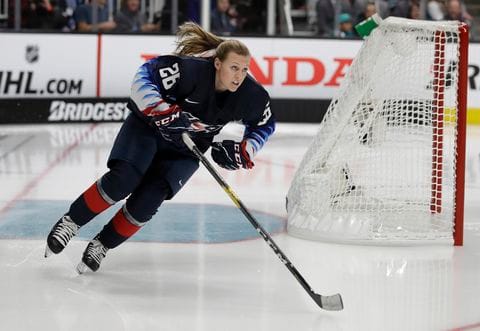
The Skills Competition took place the day before the All-Star Game on Friday January 25, 2019 at the SAP Center. The winners of each event were awarded $25,000 in prize money.  The league invited Renata Fast and Rebecca Johnston from the Canadian Women's National Team, and Brianna Decker and Kendall Coyne Schofield from the U.S. Women's National Team, to demonstrate some of the events. After Nathan MacKinnon of the Colorado Avalanche (Central Division) pulled out of the fastest-skater event due to a bruised left foot, Coyne Schofield was named as his replacement, becoming the first woman to compete in the All-Stars skills competition.
Brianna Decker demonstrated the premier passer skill, but she was not part of the competition. She was, in fact, three seconds faster than Leon Draisaitl and would have won had her time been included as they did with Kendall Coyne Schofield.  This prompted the hashtag #PayDecker on Twitter, as women's hockey salaries are a fraction of men's hockey salaries.  On January 26, hockey equipment company CCM announced they would give Decker the $25,000 she would have received for winning the competition.

 
Super Bowl LIII
History will be made Sunday night at Super Bowl 53 in Atlanta, but it will happen on the sidelines, not on the field.

That's where you'll spot Quinton Peron and Napoleon Jinnies when the New England Patriots take on the Los Angeles Rams. 
 
Peron and Jinnies will be the first male cheerleaders at the Super Bowl in NFL history, cheering for the Rams alongside their female counterparts. The men already made history at the start of this season when they -- along with dancer Jesse Hernandez of the New Orleans Saints' cheerleading squad -- became the first male cheerleaders in league history.
 
In a tweet last week after his Rams secured a spot in the big game, Peron sent out a shout out to his squadmate:  "Napoleon, you think Atlanta is ready for us?" Peron tweeted. "NAHHHHHH. We're going to the Super Bowl!"
 
The men, both dancers, made the Rams cheerleading squad back in March. Jinnies called making the team a "humbling and amazing" experience. Peron said there wasn't a good reason for him not to try out for the squad.
 
"I was at (an L.A.) Lakers game (right before making the team) and I was watching the Laker Girls," Peron told "Good Morning America" last summer, "and I was asking myself, 'Why can't I be down there?' I've choreographed for girls who dance on pro teams, I've danced with girls on various pro teams. I just thought, 'why not me?'"
 
Other teams, like the Indianapolis Colts and the Baltimore Ravens, have had stuntmen before, USA Today reported, but Peron and Jinnies danced alongside their female teammates and did the same moves during the season.
 
Peron and Jinnies' success inspired 25-year-old Jesse Hernandez to try out for the New Orleans Saints' Saintsations cheerleading team.
 
He told CNN affiliate KATC that his mom sent him a link with their story.  "She told me it was my time to shine," he said in a video posted before his final audition.
 

And then we have this bullshit.  Which, sadly, is not the first time this has happened nor will it be the last. 

The Bachelor
Caelyn, who is competing for Colton Underwood’s heart on season 23 of The Bachelor, was sexually assaulted during her sophomore year at Virginia Commonwealth University.

The 23-year-old Miss North Carolina USA opened up to Underwood, 27, about the incident during last night's episode. 
“It’s definitely the most difficult thing in the world,” a teary Miller-Keyes says to the former NFL player in a teaser for Monday’s episode. “It’s affected every single person in my life.”

After she was raped in college four years ago, “my life was flipped upside down,” Miller Keyes tells PEOPLE. “And even though I’ve moved on, it is something I will struggle with forever.”

A girlfriend at the get-together, who had not been drugged, alleged that one of the men had had sex with her while she was lying unconscious in the bed. In addition, before the alleged assault, Miller-Keyes says that a friend alleged that  “another guy, I was passed out on a couch from the drugs, and … in front of his fraternity brothers … lifted up my dress, they watched and laughed and took photos and Snapchats. It was horrible,” she told Underwood on The Bachelor.

“These situations happen when you’re safe,” she tells PEOPLE. “They don’t necessarily happen when you’re walking down a dark alley. It’s when you’re comfortable and when you let your guard down.”


Tuesday, June 26, 2018

Generational Differences

As a kid we always laughed when our elders said things like, "you kids today don't know what it's like!  Back in my day we had to walk to school!  Ten miles!  Each way!  Uphill!  In the Snow!"  I always deeply respected my grandparents and was in awe of them for having lived through the Depression and World War II.  We had the privilege of listening to Tom Brokaw not once but twice at T's Ole Miss Graduation and I love hearing him talk about "The Greatest Generation."  I remember thinking, "that's my grandparents!"

https://bleacherreport.com/articles/2782233-nfl-vs-millennials-football-struggles-to-bridge-the-generation-gap?utm_source=cnn.com&utm_medium=referral&utm_campaign=editorial

This is an interesting article about millenials in the NFL and how coaches and the league respond.  After reading this article, I decided to do a little research and learn more about the generations before and after me and why we are the way we are!  What I discovered is that I possess multi-generational thoughts and ideals.  I'm a Gen X'er, was a latch-key kid at times but I've never been a "slacker" in my life (I'm cynical by nature but never disaffected).  And, like my millennial children, I am more open than the previous generation on controversial subjects (i.e., same sex marriage, marijuana legalization, etc). 

The Silent Generation is the demographic cohort following the cohort known in the USA as the G.I. Generation. There are no precise dates for when The Silent Generation starts or ends. Demographers and researchers typically use mid-to-late 1920s as starting birth years and early-to-mid 1940s as ending birth years for this cohort.

While there were many civil rights leaders, the "Silents" are called that because many focused on their careers rather than on activism, and people in it were largely encouraged to conform with social norms. As young adults during the McCarthy Era, many members of the Silent Generation felt it was dangerous to speak out.  Time magazine coined the term "Silent Generation" in a November 5, 1951 article titled "The Younger Generation", and the term has remained ever since. The Time article said that the ambitions of this generation had shrunk, but that it had learned to make the best of bad situations. It includes most of those who fought during the Korean War. In the United States, the generation was comparatively small because the financial insecurity of the 1930s and the war in the early 1940s caused people to have fewer children. They are noted as forming the leadership of the civil rights movement as well as comprising the “silent majority”. News.com.au describes the cohort as "pre-boomers" furthering "some call them the silent generation because, unlike the noisy boomers, X'rs and Y's, they don't like to make a fuss."

They have also been named the "Lucky Few" in the 2008 book The Lucky Few: Between the Greatest Generation and the Baby Boom, by Elwood D. Carlson PhD, the Charles B. Nam Professor in Sociology of Population at Florida State University. Carlson notes that this was the first generation in American history to be smaller than the generation that preceded them. He calls the people of this generation "The Lucky Few", because even though they were born during the Great Depression and World War II, they moved into adulthood during the relatively prosperous 1950s and early 1960s. For men who served in the Korean War, their military service was not marked by high casualties as much as the previous generation. The Lucky Few also had higher employment rates than the generations before and after them, as well as better health and earlier retirement. African Americans in this generation also did better than earlier generations in education and employment.Neil Howe, writing for Forbes, describes the Silent Generation as those born from 1925 to 1941. Pew Research Center defines the generation as being born from 1928 to 1945.

The generation includes many political and civil rights leaders such as Martin Luther King, Jr., Pope Francis, Pope Benedict XVI, The 14th Dalai Lama, Malcolm X, Michael Dukakis, John McCain, Walter Mondale, Dick Cheney, Bernie Sanders, Robert F. Kennedy, Ted Kennedy, Fidel Castro, Che Guevara, Mikhail Gorbachev, B.J. Habibie, Bob Hawke, John Howard, Saddam Hussein, Ion Iliescu, Helmut Kohl, John Major, Slobodan Milošević, Madeleine Albright, John Lewis, Hosea Williams and Warren Christopher.

It includes such writers and artists as George Carlin, Ursula Andress, Julie Andrews, Anne Bancroft, Brigitte Bardot, John Cleese, Judi Dench, Audrey Hepburn, Janet Leigh, Sophia Loren, Shirley MacLaine, Marilyn Monroe, Andy Warhol, Sylvia Plath, Joan Baez, Jane Fonda, Angela Lansbury, Mary Tyler Moore, Debbie Reynolds, Elizabeth Taylor, Shirley Temple, Gene Wilder, Natalie Wood, Alan Arkin, Warren Beatty, Richard Burton, James Caan, James Coburn, James Dean, Robert Duvall, Clint Eastwood, Morgan Freeman, James Garner, Gene Hackman, Richard Harris, Dustin Hoffman, Anthony Hopkins, Dennis Hopper, Rock Hudson, James Earl Jones, Frank Langella, Jack Lemmon, Steve McQueen, Paul Newman, Jack Nicholson, Peter O'Toole, Al Pacino, Christopher Plummer, Robert Redford, Oliver Reed, Burt Reynolds, Little Richard, Chuck Berry, Ray Charles, Bo Diddley, B.B. King, Leonard Nimoy, William Shatner, George Takei, Adam West, Johnny Cash, Stephen Sondheim, James Brown, Neil Diamond, Bob Dylan, the Everly Brothers, Marvin Gaye, Glenn Gould, Don Rickles, Joan Rivers, the Beat Generation, Noam Chomsky and Richard Rorty.

Great athletes include Hank Aaron, Muhammad Ali, Yogi Berra, Jim BrownWilt Chamberlain, Bobby CharltonAlthea Gibson, Gordie HoweSonny Liston, Mickey Mantle, Roger Maris, Bob Mathias, Willie MaysBobby Moore, Jack Nicklaus, Arnold Palmer, Floyd Patterson, Pelé, Pete Rose, and Jackie Stewart.

Depending on the dates used, the generation produced no US presidents. The US essentially "jumped from George Bush Sr., the World War II veteran, to Baby Boomer Bill Clinton." However, it did produce Vice Presidents Joe Biden (born 1942), Dick Cheney (born 1941) and Walter Mondale (born 1928) and First Ladies Barbara Bush (born 1925), Rosalynn Carter (born 1927), and Jacqueline Kennedy Onassis (born 1929). Presidents Jimmy Carter and George H.W. Bush were born in what is sometimes considered to be the last year of the G.I. Generation (1924).


Baby Boomers (also known as Boomers) are the demographic cohort following the Silent Generation and preceding Generation X. There are varying timelines defining the start and the end of this cohort; demographers and researchers typically use birth years starting from the early- to mid-1940s and ending anywhere from 1960 to 1964.
 
The term "baby boomer" is also used in a cultural context, so it is difficult to achieve broad consensus of a precise date definition. Different people, organizations, and scholars have varying opinions on who is a baby boomer, both chronologically and culturally. Some define "baby boomers" as those born between 1946 and 1964. Ascribing universal attributes to any generation is tricky, and some believe it is invalid to make generalizations about individuals who happen to be born in the same timeframe. Still, many have attempted to discern in this group cultural similarities and historical impact, helping to popularize the designation "baby boomer."

 
Baby boomers are associated with a rejection or redefinition of traditional values. Many commentators, however, have disputed the extent of that rejection, noting the widespread continuity of values with older and younger generations. In Europe and North America, boomers are widely associated with privilege, as many grew up in a time of widespread government subsidies in post-war housing and education, and increasing affluence.
 
As a group, baby boomers were the wealthiest, most active, and most physically fit generation up to the era in which they arrived, and were amongst the first to grow up genuinely expecting the world to improve with time. They were also the generation that received peak levels of income; they could therefore reap the benefits of abundant levels of food, apparel, retirement programs, and sometimes even "midlife crisis" products. The increased consumerism for this generation has been regularly criticized as excessive.
 
One feature of the boomers was that they have tended to think of themselves as a special generation, very different from those that had come before or that has come afterward. In the 1960s, as the relatively large numbers of young people became teenagers and young adults, they, and those around them, created a very specific rhetoric around their cohort, and the changes they were bringing about. This rhetoric had an important impact in the self perceptions of the boomers, as well as their tendency to define the world in terms of generations, which was a relatively new phenomenon.
  
An indication of the importance put on the impact of the boomer was the selection by TIME magazine of the Baby Boom Generation as its 1966 "Man of the Year." As Claire Raines points out in Beyond Generation X, "never before in history had youth been so idealized as they were at this moment." When Generation X came along it had much to live up to in according to Raines.
Boomers are often associated with the counterculture of the 1960s, the civil rights movement, and the "second-wave" feminist cause of the 1970s. Conversely, many trended in moderate to conservative directions opposite to the counterculture, especially those making professional careers in the military (officer and enlisted), law enforcement, business, blue collar trades, and Republican Party politics. They are also associated with the spending trends and narcissism of the "Me" generation.
People often take it for granted that each succeeding generation will be "better off" than the one before it. When Generation X came along just after the boomers, they would be the first generation to enjoy a lesser quality of life than the generation preceding it.
 
Baby boomers continue to have a big effect on politics, as the United States presidential election, 2016 came down to two controversial candidates in Hillary Clinton and Donald Trump, both boomers, with a majority of Trump's support coming from the Baby Boomer generation. Three American presidents were born in 1946: Bill Clinton, George W. Bush and Donald Trump.
 
 
Generation X, or Gen X, is the demographic cohort following the baby boomers and preceding the Millennials. There are no precise dates for when Generation X starts or ends. Demographers and researchers typically use birth years ranging from the early-to-mid 1960s to the early 1980s.

 
Members of Generation X were children during a time of shifting societal values and as children were sometimes called the "latchkey generation", due to reduced adult supervision as children compared to previous generations, a result of increasing divorce rates and increased maternal participation in the workforce, prior to widespread availability of childcare options outside the home. As adolescents and young adults, they were dubbed the "MTV Generation" (a reference to the music video channel of the same name). In the 1990s they were sometimes characterized as slackers, cynical and disaffected. Some of the cultural influences on Gen X youth were the musical genres of grunge and hip hop music, and indie films. In midlife, research describes them as active, happy, and achieving a work–life balance. The cohort has been credited with entrepreneurial tendencies.
 
Demographers William Strauss and Neil Howe, who authored several books on generations, including the 1993 book, 13th Gen: Abort, Retry, Ignore, Fail?, specifically on Generation X reported that Gen Xers were children at a time when society was less focused on children and more focused on adults. Gen Xers were children during a time of increasing divorce rates, with divorce rates doubling in the mid-1960s, before peaking in 1980.  Strauss and Howe described a cultural shift where the long held societal value of staying together for the sake of the children was replaced with a societal value of parental and individual self-actualization. Strauss wrote that society "moved from what Leslie Fiedler called a 1950s-era 'cult of the child' to what Landon Jones called a 1970s-era 'cult of the adult'."
 
The Gen X childhood coincided with the sexual revolution, which Susan Gregory Thomas described in her book In Spite of Everything as confusing and frightening for children in cases where a parent would bring new sexual partners into their home. Thomas also discussed how divorce was different during the Gen X childhood, with the child having a limited or severed relationship with one parent following divorce, often the father, due to differing societal and legal expectations. In the 1970s, only 9 U.S states allowed for joint custody of children, which has since been adopted by all 50 states following a push for joint custody during the mid-1980s.
 
The time period of the Gen X childhood saw an increase in latchkey children, leading to the terminology of the "latchkey generation" for Generation X. These latchkey children lacked adult supervision in the hours between the end of the school day and when a parent returned home from work in the evening, and for longer periods of time during the summer. Latchkey children became common among all socioeconomic demographics, but were particularly common among middle and upper class children. The higher the educational attainment of the parents, the higher the odds the children of this time would be latchkey children, due to increased maternal participation in the workforce at a time before childcare options outside the home were widely available. McCrindle Research Center described the cohort as "the first to grow up without a large adult presence, with both parents working", stating this led to Gen Xers being more peer-oriented than previous generations.
 
In the US, Generation X was the first cohort to grow up post-integration. They were described in a marketing report by Specialty Retail as the kids who "lived the civil rights movement." They were among the first children to be bused to attain integration in the public school system. In the 1990s, demographer William Strauss reported Gen Xers were "by any measure the least racist of today's generations". In the US, Title IX, which passed in 1972, provided increased athletic opportunities to Gen X girls in the public school setting.  In Russia, Generation Xers are referred to as "the last Soviet children", as the last children to come of age prior to the downfall of communism in their nation and prior to the fall of the Soviet Union.
 
Politically, in the United States, the Gen X childhood coincided with a time when government funding tended to be diverted away from programs for children and often instead directed toward the elderly population, with cuts to Medicaid and programs for children and young families, and protection and expansion of Medicare and Social Security for the elderly population. One in five American children grew up in poverty during this time. These programs for the elderly were not tied to economic need. Congressman David Durenberger criticized this political situation, stating that while programs for poor children and for young families were cut, the government provided "free health care to elderly millionaires".
 
Gen Xers came of age or were children during the crack epidemic, which disproportionately impacted urban areas and also the African American community in the US. Drug turf battles increased violent crime, and crack addiction impacted communities and families. Between 1984 and 1989, the homicide rate for black males aged 14 to 17 doubled in the US, and the homicide rate for black males aged 18 to 24 increased almost as much. The crack epidemic had a destabilizing impact on families with an increase in the number of children in foster care. Generation X was the first cohort to come of age with MTV and are sometimes called the MTV Generation.  They experienced the emergence of music videos, grunge, alternative rock and hip hop.
 
The emergence of AIDS coincided with Gen X's adolescence, with the disease first clinically observed in the United States in 1981. By 1985, an estimated one to two million Americans were HIV positive. As the virus spread, at a time before effective treatments were available, a public panic ensued. Sex education programs in schools were adapted to address the AIDS epidemic which taught Gen X students that sex could kill you. Gen Xers were the first children to have access to computers in their homes and schools. Generally, Gen Xers are the children of the Silent Generation and older Baby Boomers.
 
In the 1990s, media pundits and advertisers struggled to define the cohort, typically portraying them as "unfocused twentysomethings". A MetLife report noted: "media would portray them as the Friends generation: rather self-involved and perhaps aimless...but fun." In France, Gen Xers were sometimes referred to as 'Génération Bof' because of their tendency to use the word 'bof', which translated into English means 'whatever". Gen Xers were often portrayed as apathetic or as "slackers", a stereotype which was initially tied to Richard Linklater's comedic and essentially plotless 1991 film Slacker. After the film was released, "journalists and critics thought they put a finger on what was different about these young adults in that 'they were reluctant to grow up' and 'disdainful of earnest action'."
 
Stereotypes of Gen X young adults also included that they were "bleak, cynical, and disaffected". Such stereotypes prompted sociological research at Stanford University to study the accuracy of the characterization of Gen X young adults as cynical and disaffected.
 
In 1990, Time magazine published an article titled Living:Proceeding With Caution, which described those in their 20s as aimless and unfocused; however, in 1997, they published an article titled "Generation X Reconsidered", which retracted the previously reported negative stereotypes and reported positive accomplishments, citing Gen Xers' tendency to found technology start ups and small businesses as well as Gen Xers' ambition, which research showed was higher among Gen X young adults than older generations. As the 1990s and 2000s progressed, Gen X gained a reputation for entrepreneurship. In 1999, The New York Times dubbed them "Generation 1099", describing them as the "once pitied but now envied group of self-employed workers whose income is reported to the Internal Revenue Service not on a W-2 form, but on Form 1099". In 2002, Time magazine published an article titled Gen Xers Aren't Slackers After All, reporting four out of five new businesses were the work of Gen Xers.
 
In 2001, sociologist Mike Males reported confidence and optimism common among the cohort saying "surveys consistently find 80% to 90% of Gen Xers self-confident and optimistic." In August 2001, Males wrote "these young Americans should finally get the recognition they deserve", praising the cohort and stating that "the permissively raised, universally deplored Generation X is the true 'great generation,' for it has braved a hostile social climate to reverse abysmal trends", describing them as the hardest-working group since the World War II generation, which was dubbed by Tom Brokaw as "The Greatest Generation". He reported Gen Xers' entrepreneurial tendencies helped create the high-tech industry that fueled the 1990s economic recovery.
 
In the US, Gen Xers were described as the major heroes of the September 11 terrorist attacks by demographer William Strauss. The firefighters and police responding to the attacks were predominantly Generation Xers. Additionally, the leaders of the passenger revolt on United Airlines Flight 93 were predominantly Gen Xers. Demographer Neil Howe reported survey data showed Gen Xers were cohabitating and getting married in increasing numbers following the terrorists attacks, with Gen X survey respondents reporting they no longer wanted to live alone. In October 2001, Seattle Post-Intelligencer wrote of Generation Xers: "now they could be facing the most formative events of their lives and their generation". The Greensboro News & Record reported Gen Xers "felt a surge of patriotism since terrorists struck" reporting many were responding to the crisis of the terrorist attacks by giving blood, working for charities, donating to charities, and by joining the military to fight The War on Terror. The Jury Expert, a publication of The American Society of Trial Consultants, reported: "Gen X members responded to the terrorist attacks with bursts of patriotism and national fervor that surprised even themselves".
 
 
Millennials (also known as Generation Y) are the generational demographic cohort following Generation X. There are no precise dates for when this cohort starts or ends; demographers and researchers typically use the early 1980s as starting birth years and the mid-1990s to early 2000s as ending birth years. Millennials are sometimes referred to as "echo boomers" due to a major surge in birth rates in the 1980s and 1990s, and because millennials are often the children of the baby boomers. The 20th-century trend toward smaller families in developed countries continued, however, so the relative impact of the "baby boom echo" was generally less pronounced than the post–World War II baby boom.
 
Although Millennial characteristics vary by region, depending on social and economic conditions, the generation is generally marked by an increased use and familiarity with communications, media, and digital technologies. In most parts of the world, their upbringing was marked by an increase in a liberal approach to politics and economics; the effects of this environment are disputed. The Great Recession has had a major impact on this generation because it has caused historically high levels of unemployment among young people, and has led to speculation about possible long-term economic and social damage to this generation.
 
In August 1993, an Advertising Age editorial coined the phrase Generation Y to describe those who were aged 11 or younger as well as the teenagers of the upcoming ten years who were defined as different from Generation X. According to journalist Bruce Horovitz, in 2012, Ad Age "threw in the towel by conceding that millennials is a better name than Gen Y", and by 2014, a past director of data strategy at Ad Age said to NPR "the Generation Y label was a placeholder until we found out more about them". Millennials are sometimes called Echo Boomers, due to their being the offspring of the baby boomers and due to the significant increase in birth rates from the early 1980s to mid 1990s, mirroring that of their parents. In the United States, birth rates peaked in August 1990 and a 20th-century trend toward smaller families in developed countries continued. 
 
Psychologist Jean Twenge described millennials as "Generation Me" in her 2006 book Generation Me: Why Today’s Young Americans Are More Confident, Assertive, Entitled—and More Miserable Than Ever Before, which was updated in 2014. In 2013, Time magazine ran a cover story titled Millennials: The Me Me Me Generation. Newsweek used the term Generation 9/11 to refer to young people who were between the ages of 10 and 20 years during the terrorist acts of 11 September 2001. The first reference to "Generation 9/11" was made in the cover story of the 12 November 2001 issue of Newsweek. Alternative names for this group proposed include Generation We,Global Generation, Generation Next and the Net Generation.
 
A 2018 report from Pew Research Center defines Millennials as born from 1981-1996, choosing these dates for "key political, economic and social factors", including September 11th terrorist attacks. This range makes Millennials 5-20 years old at the time of the attacks so "old enough to comprehend the historical significance". Pew indicated they'd use 1981-1996 for future publications but would remain open to date recalibration. 
 
In his 2008 book The Lucky Few: Between the Greatest Generation and the Baby Boom, author Elwood Carlson defined this cohort as born between 1983–2001 based on the upswing in births after 1983 and finishing with the "political and social challenges" that occurred after the September 11 terrorist acts. In 2016, U.S Pirg described millennials as those born between 1983 and 2000. On the American television program Survivor, for their 33rd season, subtitled Millennials vs. Gen X, the "Millennial tribe" consisted of individuals born between 1984 and 1997.
 
 Authors William Strauss and Neil Howe believe that each generation has common characteristics that give it a specific character with four basic generational archetypes, repeating in a cycle. According to their hypothesis, they predicted millennials will become more like the "civic-minded" G.I. Generation with a strong sense of community both local and global. Strauss and Howe ascribe seven basic traits to the Millennial cohort: special, sheltered, confident, team-oriented, conventional, pressured, and achieving. Arthur E. Levine, author of When Hope and Fear Collide: A Portrait of Today's College Student describes these generational images as "stereotypes".
 
Strauss and Howe's research has been influential, but it also has critics. Psychologist Jean Twenge says Strauss and Howe's assertions are overly-deterministic, non-falsifiable, and unsupported by rigorous evidence. Twenge, the author of the 2006 book Generation Me, considers millennials, along with younger members of Generation X, to be part of what she calls "Generation Me".Twenge attributes millennials with the traits of confidence and tolerance, but also describes a sense of entitlement and narcissism, based on personality surveys showing increased narcissism among millennials compared to preceding generations when they were teens and in their twenties. She questions the predictions of Strauss and Howe that this generation will turn out civic-minded. A 2016 study by SYZYGY a digital service agency, found millennials in the U.S. continue to exhibit elevated scores on the Narcissistic Personality Inventory as they age, finding millennials exhibited 16% more narcissism than older adults, with males scoring higher on average than females. The study examined two types of narcissism: grandiose narcissism, described as "the narcissism of extraverts, characterized by attention-seeking behavior, power and dominance", and vulnerable narcissism, described as "the narcissism of introverts, characterized by an acute sense of self-entitlement and defensiveness."
 
The University of Michigan's "Monitoring the Future" study of high school seniors (conducted continually since 1975) and the American Freshman survey, conducted by UCLA's Higher Education Research Institute of new college students since 1966, showed an increase in the proportion of students who consider wealth a very important attribute, from 45% for Baby Boomers (surveyed between 1967 and 1985) to 70% for Gen Xers, and 75% for millennials. The percentage who said it was important to keep abreast of political affairs fell, from 50% for Baby Boomers to 39% for Gen Xers, and 35% for millennials. The notion of "developing a meaningful philosophy of life" decreased the most across generations, from 73% for Boomers to 45% for millennials. The willingness to be involved in an environmental cleanup program dropped from 33% for Baby Boomers to 21% for millennials. Millennials show a willingness to vote more than previous generations. With voter rates being just below 50% for the last four presidential cycles, they have already surpassed Gen Xers of the same age who were at just 36%.
 
A 2013 Pew Research Poll found that 84% of millennials, born since 1980, who were at that time between the ages of 18 and 32, favored legalizing the use of marijuana. In 2015, the Pew Research Center also conducted research regarding generational identity that said a majority did not like the "Millennial" label.
 
In March 2014, the Pew Research Center issued a report about how "millennials in adulthood" are "detached from institutions and networked with friends."The report said millennials are somewhat more upbeat than older adults about America's future, with 49% of millennials saying the country’s best years are ahead though they're the first in the modern era to have higher levels of student loan debt and unemployment.
 
Fred Bonner, a Samuel DeWitt Proctor Chair in Education at Rutgers University and author of Diverse Millennial Students in College: Implications for Faculty and Student Affairs, believes that much of the commentary on the Millennial Generation may be partially accurate, but overly general and that many of the traits they describe apply primarily to "white, affluent teenagers who accomplish great things as they grow up in the suburbs, who confront anxiety when applying to super-selective colleges, and who multitask with ease as their helicopter parents hover reassuringly above them." During class discussions, Bonner listened to black and Hispanic students describe how some or all of the so-called core traits did not apply to them. They often said that the "special" trait, in particular, is unrecognizable. Other socio-economic groups often do not display the same attributes commonly attributed to millennials. "It's not that many diverse parents don't want to treat their kids as special," he says, "but they often don't have the social and cultural capital, the time and resources, to do that."
 
In his book Fast Future, author David Burstein describes millennials' approach to social change as "pragmatic idealism" with a deep desire to make the world a better place, combined with an understanding that doing so requires building new institutions while working inside and outside existing institutions.
 
Elza Venter, an educational psychologist and lecturer at Unisa, South Africa, in the Department of Psychology of Education, believes members of Generation Y are digital natives because they have grown up experiencing digital technology and have known it all their lives. Prensky coined the concept ‘digital natives’ because this generation are ‘native speakers of the digital language of computers, video games and the internet’. This generation spans 20 years and its older members use a combination of face-to-face communication and computer mediated communication, while its younger members use mainly electronic and digital technologies for interpersonal communication.
 
There are vast, and conflicting, amounts of literature and empirical studies discussing the existence of generational differences as it pertains to the workplace. The majority of research concludes millennials differ from both their generational cohort predecessors, and can be characterized by a preference for a flat corporate culture, an emphasis on work-life balance and social consciousness.
According to authors from Florida International University, original research performed by Howe and Strauss as well as Yu & Miller suggest Baby Boomers resonate primarily with loyalty, work ethic, steady career path, and compensation when it comes to their professional lives. Generation X on the other hand, started shifting preferences towards an improved work-life balance with a heightened focus on individual advancement, stability, and job satisfaction. Meanwhile, millennials place an emphasis on producing meaningful work, finding a creative outlet, and have a preference for immediate feedback. In the article "Challenges of the Work of the Future," it is also stressed that millennials working at the knowledge-based jobs very often assume personal responsibility in order to make the most of what they do. As they are not satisfied with remaining for a long period of time at the same job, their career paths become more dynamic and less predictable. Findings also suggest the introduction of social media has augmented collaborative skills and created a preference for a team-oriented environment.
 
In the 2010 the Journal of Business and Psychology, contributors Myers and Sadaghiani find millennials "expect close relationships and frequent feedback from supervisors" to be a main point of differentiation.Multiple studies observe millennials’ associating job satisfaction with free flow of information, strong connectivity to supervisors, and more immediate feedback. Hershatter and Epstein, researchers from Emory University, argue a lot of these traits can be linked to millennials entering the educational system on the cusp of academic reform, which created a much more structured educational system. Some argue in the wake of these reforms, such as the No Child Left Behind Act, millennials have increasingly sought the aid of mentors and advisers, leading to 66% of millennials seeking a flat work environment.
 
Hershatter and Epstein also stress a growing importance on work-life balance. Studies show nearly one-third of students' top priority is to "balance personal and professional life".The Brain Drain Study shows nearly 9 out of 10 millennials place an importance on work-life balance, with additional surveys demonstrating the generation to favor familial over corporate values.Studies also show a preference for work-life balance, which contrasts to the Baby Boomers' work-centric attitude.
Data also suggests millennials are driving a shift towards the public service sector. In 2010, Myers and Sadaghiani published research in the Journal of Business and Psychology stating heightened participation in the Peace Corps and AmeriCorps as a result of millennials, with volunteering being at all-time highs.Volunteer activity between 2007 and 2008 show the Millennial age group experienced almost three-times the increase of the overall population, which is consistent with a survey of 130 college upperclassmen depicting an emphasis on altruism in their upbringing.This has led, according to a Harvard University Institute of Politics, six out of ten millennials to consider a career in public service.
 
The 2014 Brookings publication shows a generational adherence to corporate social responsibility, with the National Society of High School Scholars (NSHSS) 2013 survey and Universum’s 2011 survey, depicting a preference to work for companies engaged in the betterment of society.Millennials' shift in attitudes has led to data depicting 64% of millennials would take a 60% pay cut to pursue a career path aligned with their passions, and financial institutions have fallen out of favor with banks comprising 40% of the generation's least liked brands.
 
In 2008, author Ron Alsop called the millennials "Trophy Kids," a term that reflects a trend in competitive sports, as well as many other aspects of life, where mere participation is frequently enough for a reward. It has been reported that this is an issue in corporate environments. Some employers are concerned that millennials have too great expectations from the workplace. Some studies predict they will switch jobs frequently, holding many more jobs than Gen Xers due to their great expectations. Psychologist Jean Twenge reports data suggests there are differences between older and younger millennials regarding workplace expectations, with younger millennials being "more practical" and "more attracted to industries with steady work and are more likely to say they are willing to work overtime" which Twenge attributes to younger millennials coming of age following the financial crisis of 2007-2008.
 
Newer research shows that millennials change jobs for the same reasons as other generations—namely, more money and a more innovative work environment. They look for versatility and flexibility in the workplace, and strive for a strong work–life balance in their jobs and have similar career aspirations to other generations, valuing financial security and a diverse workplace just as much as their older colleagues.
  
Surveys of political attitudes among millennials in the United Kingdom have suggested increasingly social liberal views, as well as higher overall support for classical liberal economic policies than preceding generations. They are more likely to support same-sex marriage and the legalization of drugs. The Economist parallels this with millennials in the United States, whose attitudes are more supportive of social liberal policies and same-sex marriage relative to other demographics.They are also more likely to oppose animal testing for medical purposes than older generations. Pew Research described Millennials as "the force of the youth vote" and as part of the political conversation which helped elect the first U.S. black president, describing Millennials as between 12 and 27 during the 2008 U.S Presidential election.
 
Bernie Sanders, a self-proclaimed democratic socialist and democratic candidate in the 2016 United States presidential election, was the most popular candidate among Millennial voters in the primary phase, having garnered more votes from people under 30 in 21 states than the major parties' candidates, Donald Trump and Hillary Clinton, did combined. In April 2016, The Washington Post viewed him as changing the way millennials viewed politics, saying, "He's not moving a party to the left. He's moving a generation to the left."[Bernie Sanders referred to millennials as "the least prejudiced generation in the history of the United States". A 2014 poll for the libertarian Reason magazine suggested that American millennials were social liberals and fiscal centrists, more often than their global peers. The magazine predicted that millennials would become more conservative on fiscal issues once they started paying taxes.
 
In some countries, including the U.S. and the UK, millennials are more likely to support political correctness than members of older generations. In 2015, a Pew Research study found 40% of millennials in the United States supported government restriction of public speech offensive to minority groups. Support for restricting offensive speech was lower among older generations, with 27% of Gen Xers, 24% of Baby Boomers, and only 12% of the Silent Generation supporting such restrictions. Pew Research noted similar age related trends in the United Kingdom, but not in Germany and Spain, where millennials were less supportive of restricting offensive speech than older generations. In France, Italy and Poland no significant age differences were observed. In the U.S. and UK, millennials have brought changes to higher education via drawing attention to microaggressions and advocating for implementation of safe spaces and trigger warnings in the university setting. Critics of such changes have raised concerns regarding their impact on free speech, asserting these changes can promote censorship, while proponents have described these changes as promoting
 
Economic prospects for some millennials have declined largely due to the Great Recession in the late 2000s.Several governments have instituted major youth employment schemes out of fear of social unrest due to the dramatically increased rates of youth unemployment. Underemployment is also a major factor. In the U.S. the economic difficulties have led to dramatic increases in youth poverty, unemployment, and the numbers of young people living with their parents. In April 2012, it was reported that half of all new college graduates in the US were still either unemployed or underemployed. It has been argued that this unemployment rate and poor economic situation has given millennials a rallying call with the 2011 Occupy Wall Street movement. However, according to Christine Kelly, Occupy is not a youth movement and has participants that vary from the very young to very old.
 
A variety of names have emerged in various European countries hard hit following the financial crisis of 2007–2008 to designate young people with limited employment and career prospects.These groups can be considered to be more or less synonymous with millennials, or at least major sub-groups in those countries. The Generation of €700 is a term popularized by the Greek mass media and refers to educated Greek twixters of urban centers who generally fail to establish a career. In Greece, young adults are being "excluded from the labor market" and some "leave their country of origin to look for better options". They're being "marginalized and face uncertain working conditions" in jobs that are unrelated to their educational background, and receive the minimum allowable base salary of €700 per month. This generation evolved in circumstances leading to the Greek debt crisis and some participated in the 2010–2011 Greek protests. In Spain, they're referred to as the mileurista (for €1,000 per month), in France "The Precarious Generation," and as in Spain, Italy also has the "milleurista"; generation of 1,000 euros (per month).
 
In 2015, millennials in New York City were reported as earning 20% less than the generation before them, as a result of entering the workforce during the great recession. Despite higher college attendance rates than Generation X, many were stuck in low-paid jobs, with the percentage of degree-educated young adults working in low-wage industries rising from 23% to 33% between 2000 and 2014. In 2016, research from the Resolution Foundation found millennials in the UK earned £8,000 less in their 20s than Generation X, describing millennials as "on course to become the first generation to earn less than the one before".
 
Generation Flux is a neologism and psychographic (not demographic) designation coined by Fast Company for American employees who need to make several changes in career throughout their working lives due to the chaotic nature of the job market following the Great Recession. Societal change has been accelerated by the use of social media, smartphones, mobile computing, and other new technologies. Those in "Generation Flux" have birth-years in the ranges of both Generation X and millennials. "Generation Sell" was used by author William Deresiewicz to describe millennials' interest in small businesses.
 
Millennials are expected to make up approximately half of the U.S. workforce by 2020. Millennials are the most highly educated and culturally diverse group of all generations, and have been regarded as hard to please when it comes to employers. To address these new challenges, many large firms are currently studying the social and behavioral patterns of millennials and are trying to devise programs that decrease intergenerational estrangement, and increase relationships of reciprocal understanding between older employees and millennials. The UK's Institute of Leadership and Management researched the gap in understanding between Millennial recruits and their managers in collaboration with Ashridge Business School. The findings included high expectations for advancement, salary and for a coaching relationship with their manager, and suggested that organizations will need to adapt to accommodate and make the best use of millennials. In an example of a company trying to do just this, Goldman Sachs conducted training programs that used actors to portray millennials who assertively sought more feedback, responsibility, and involvement in decision making. After the performance, employees discussed and debated the generational differences they saw played out.
 
Millennials have benefited the least from the economic recovery following the Great Recession, as average incomes for this generation have fallen at twice the general adult population's total drop and are likely to be on a path toward lower incomes for at least another decade. A Bloomberg L.P. article wrote that "Three and a half years after the worst recession since the Great Depression, the earnings and employment gap between those in the under-35 population and their parents and grandparents threatens to unravel the American dream of each generation doing better than the last. The nation's younger workers have benefited least from an economic recovery that has been the most uneven in recent history."
 
In 2014, millennials were entering an increasingly multi-generational workplace. Even though research has shown that millennials are joining the workforce during a tough economic time they still have remained optimistic, as shown when about nine out of ten millennials surveyed by the Pew Research Center said that they currently have enough money or that they will eventually reach their long-term financial goals.
 
American sociologist Kathleen Shaputis labeled millennials as the Boomerang Generation or Peter Pan generation, because of the members' perceived tendency for delaying some rites of passage into adulthood for longer periods than most generations before them. These labels were also a reference to a trend toward members living with their parents for longer periods than previous generations.  Kimberly Palmer regards the high cost of housing and higher education, and the relative affluence of older generations, as among the factors driving the trend. Questions regarding a clear definition of what it means to be an adult also impacts a debate about delayed transitions into adulthood and the emergence of a new life stage, Emerging Adulthood. A 2012 study by professors at Brigham Young University found that college students were more likely to define "adult" based on certain personal abilities and characteristics rather than more traditional "rite of passage" events. Larry Nelson noted that "In prior generations, you get married and you start a career and you do that immediately. What young people today are seeing is that approach has led to divorces, to people unhappy with their careers … The majority want to get married […] they just want to do it right the first time, the same thing with their careers." Their expectations have had a dampening effect on millennials' rate of marriage.
 
A 2013 joint study by sociologists at the University of Virginia and Harvard University found that the decline and disappearance of stable full-time jobs with health insurance and pensions for people who lack a college degree has had profound effects on working-class Americans, who now are less likely to marry and have children within marriage than those with college degrees. Data from a 2014 study of U.S. millennials revealed over 56% of this cohort considers themselves as part of the working class, with only approximately 35% considering themselves as part of the middle class; this class identity is the lowest polling of any generation.
 
Research by the Urban Institute conducted in 2014, projected that if current trends continue, millennials will have a lower marriage rate compared to previous generations, predicting that by age 40, 30.7% of millennial women will remain single, approximately twice the share of their single Gen X counterparts. The data showed similar trends for males. A 2016 study from Pew Research showed millennials delay some activities considered rites of passage of adulthood with data showing young adults aged 18–34 were more likely to live with parents than with a relationship partner, an unprecedented occurrence since data collection began in 1880. Data also showed a significant increase in the percentage of young adults living with parents compared to the previous demographic cohort, Generation X, with 23% of young adults aged 18–34 living with parents in 2000, rising to 32% in 2014. Additionally, in 2000, 43% of those aged 18–34 were married or living with a partner, with this figure dropping to 31.6% in 2014. High student debt is described as one reason for continuing to live with parents, but may not be the dominant factor for this shift as the data shows the trend is stronger for those without a college education. Richard Fry, a senior economist for Pew Research said of millennials, "they're the group much more likely to live with their parents." furthering "they're concentrating more on school, careers and work and less focused on forming new families, spouses or partners and children." 
 
According to a cross-generational study comparing millennials to Generation X conducted at Wharton School of Business, more than half of Millennial undergraduates surveyed do not plan to have children. The researchers compared surveys of the Wharton graduating class of 1992 and 2012. In 1992, 78% of women planned to eventually have children dropping to 42% in 2012. The results were similar for male students. The research revealed among both genders the proportion of undergraduates who reported they eventually planned to have children had dropped in half over the course of a generation.
 
In their 2007 book, authors Junco and Mastrodicasa expanded on the work of William Strauss and Neil Howe to include research-based information about the personality profiles of millennials, especially as it relates to higher education. They conducted a large-sample (7,705) research study of college students. They found that Next Generation college students, born between 1983–1992, were frequently in touch with their parents and they used technology at higher rates than people from other generations. In their survey, they found that 97% of these students owned a computer, 94% owned a mobile phone, and 56% owned an MP3 player. They also found that students spoke with their parents an average of 1.5 times a day about a wide range of topics. Other findings in the Junco and Mastrodicasa survey revealed 76% of students used instant messaging, 92% of those reported multitasking while instant messaging, 40% of them used television to get most of their news, and 34% of students surveyed used the Internet as their primary news source. Older millennials came of age prior to widespread usage and availability of smartphones, defined as those born 1988 and earlier, in contrast to younger millennials, those born in 1989 and later, who were exposed to this technology in their teen years.
 
Gen Xers and millennials were the first to grow up with computers in their homes. In a 1999 speech at the New York Institute of Technology, Microsoft Chairman and CEO Bill Gates encouraged America's teachers to use technology to serve the needs of the first generation of kids to grow up with the Internet. Some millennials enjoy having hundreds of channels from cable TV. However, some other millennials do not even have a TV, so they watch media over the Internet using smartphones and tablets. One of the most popular forms of media use by millennials is social networking. In 2010, research was published in the Elon Journal of Undergraduate Research which claimed that students who used social media and decided to quit showed the same withdrawal symptoms of a drug addict who quit their stimulant. Marc Prensky coined the term "digital native" to describe "K through college" students in 2001, explaining they "represent the first generations to grow up with this new technology." Millennials are identified as "digital natives" by the Pew Research Center which conducted a survey titled Millennials in Adulthood.
 
Millennials use social networking sites, such as Facebook, to create a different sense of belonging, make acquaintances, and to remain connected with friends. In the Frontline episode "Generation Like" there is discussion about millennials, their dependence on technology, and the ways the social media sphere is commoditized.
 
Strauss and Howe's book titled Millennials Rising: The Next Great Generation describes the Millennial generation as "civic-minded", rejecting the attitudes of the Baby Boomers and Generation X. Since the 2000 U.S. Census, which allowed people to select more than one racial group, millennials in abundance have asserted the ideal that all their heritages should be respected, counted, and acknowledged. Millennials are the children of Baby Boomers or Generation X, while some older members may have parents from the Silent Generation. A 2013 poll in the United Kingdom found that Generation Y was more "open-minded than their parents on controversial topics". Of those surveyed, nearly 75% supported same-sex marriage.
 
A 2013 Pew Research Poll found that 84% of millennials, born since 1980, who were at that time between the ages of 18 and 32, favored legalizing the use of marijuana. In 2015, the Pew Research Center also conducted research regarding generational identity. It was discovered that millennials are less likely to strongly identify with the generational term when compared to Generation X or to the Baby Boomers, with only 40% of those born between 1981 and 1997 identifying as part of the Millennial Generation. Among older millennials, those born 1981–1988, Pew Research found 43% personally identified as members of the older demographic cohort, Generation X, while only 35% identified as millennials. Among younger millennials (born 1989–1997), generational identity was not much stronger, with only 45% personally identifying as millennials. It was also found that millennials chose most often to define itself with more negative terms such as self-absorbed, wasteful or greedy. In this 2015 report, Pew defined millennials with birth years ranging from 1981 onwards.
 
Millennials came of age in a time where the entertainment industry began to be affected by the Internet. In addition to millennials being the most ethnically and racially diverse compared to the generations older than they are, they are also on pace to be the most formally educated. As of 2008, 39.6% of millennials between the ages of 18 and 24 were enrolled in college, which was an American record. Along with being educated, millennials also tend to upbeat. As stated above in the economic prospects section, about 9 out of 10 millennials feel as though they have enough money or that they will reach their long-term financial goals, even during the tough economic times, and they are more optimistic about the future of the U.S. Additionally, millennials are also more open to change than older generations. According to the Pew Research Center that did a survey in 2008, millennials are the most likely of any generation to self-identify as liberals and are also more supportive of progressive domestic social agenda than older generations. Finally, millennials are less overtly religious than the older generations. About one in four millennials are unaffiliated with any religion, a considerably higher ratio than that of older generations when they were the ages of millennials.

Total Pageviews

My Blog List

Some of My Favorite Quotes

"You know you're in love when you can't fall asleep because reality is finally better than your dreams." -- Dr. Seuss

"Nothing makes a woman more beautiful than the belief that she is beautiful." -- Sophia Loren


"There must be quite a few things a hot bath won't cure, but I don't know many of them." -- Sylvia Plath

“Life is too important to be taken seriously.” – Oscar Wilde

If people are truly, madly, deeply in love with each other, they will find a way.~Gilda Radner

“Never judge a day by its weather. Sunshine is uplifting; rain, nourishing; wind, exhilarating; snow, cleansing; hail, stimulating. Any weather is better than none.” -- Author Unknown

"Everything you see I owe to spaghetti." -- Sophia Loren

"I know I'm vulgar, but would you have me any other way?" -- Elizabeth Taylor

"After thirty, a body has a mind of its own." -- Bette Midler

"Cherish forever what makes you unique, 'cuz you're really a yawn if it goes." -- Bette Midler

“I know I can be diva-ish sometimes, but I have to be in control. The nature of my life, the nature of what I do, is divadom, it really is." -- Mariah Carey

"I want minimum information given with maximum politeness." -- Jackie Kennedy Onassis

"I've been called a diva, queen diva, diva supreme, and I love it. However, that's really for others to decide, not me." -- Aretha Franklin

"No one loves a party more than I. I am a people person." -- Aretha Franklin

"There are many little ways to enlarge your child's world. Love of books is the best of all." -- Jackie Kennedy Onassis
Blogging Resources for Women
 
Designed by Munchkin Land Designs • Copyright 2011 • All Rights Reserved